


Hi Everyone,
Happy Easter Eve. Yes, the post is out early! This is the one I foolishly thought would be ready on Thursday. Alas, the extra time allowed me to put a bit more spit and polish on it. This is a detailed two-parter. I strived to cover the major curtain hardware topics. Of course, it’s impossible to hit everything. Please note, I did not attempt to cover cafe curtains or cafe curtain hardware, and other less common installations.
If you’ve already read part 1 and would like to skip to part 2, please click the link below.
Part 2 Begins Here
Otherwise, if you’re here for the first time, please start directly below.
Part 1, Wednesday April 1, 2026
Hi Everyone,
As promised, this post about curtain hardware is the companion to Sunday’s post about
how to get window treatments like you see in magazines.
Again, this is a fairly broad field, but for the last 30 years or so, most A-list designers are using only one kind of rod.
It was and still is a thin rod, usually no more than 3/4″ and sometimes 5/8″ (usually the second rod for sheers), a wrought iron rod with a small finial and rings to hold up the drapes.
Sure, in more formal settings, designers used heavier, often fluted wooden versions.
I did them once.
Yes, one time. They were lovely, but for the four windows back in 1997, it cost my client over $7,000 for four rods. Today, they would be at least double.
After that, I began embracing the choice by the designers I admired, Victoria Hagan, Suzanne Kasler, Barbara Barry and many others.
We didn’t always do a decorative rod with rings.
On occasion, I would do a valance.
Get ready to see another side of me.
It’s a small side. haha However, beginning about 19 years ago, I had some wonderful clients in Chappaqua, who moved to a slightly smaller home in Larchmont. If you know Westchester County, I don’t need to say anything else.
I was exceedingly fond of the Carsons. (not their real last name) They had a very traditional English country aesthetic, a la Mario Buatta. So, when I showed them this not terribly expensive print from Duralee, their eyes lit up.
You might notice it is a bit on the Talbots’ side of things; however, it suited the Carsons’ home and furnishings beautifully.
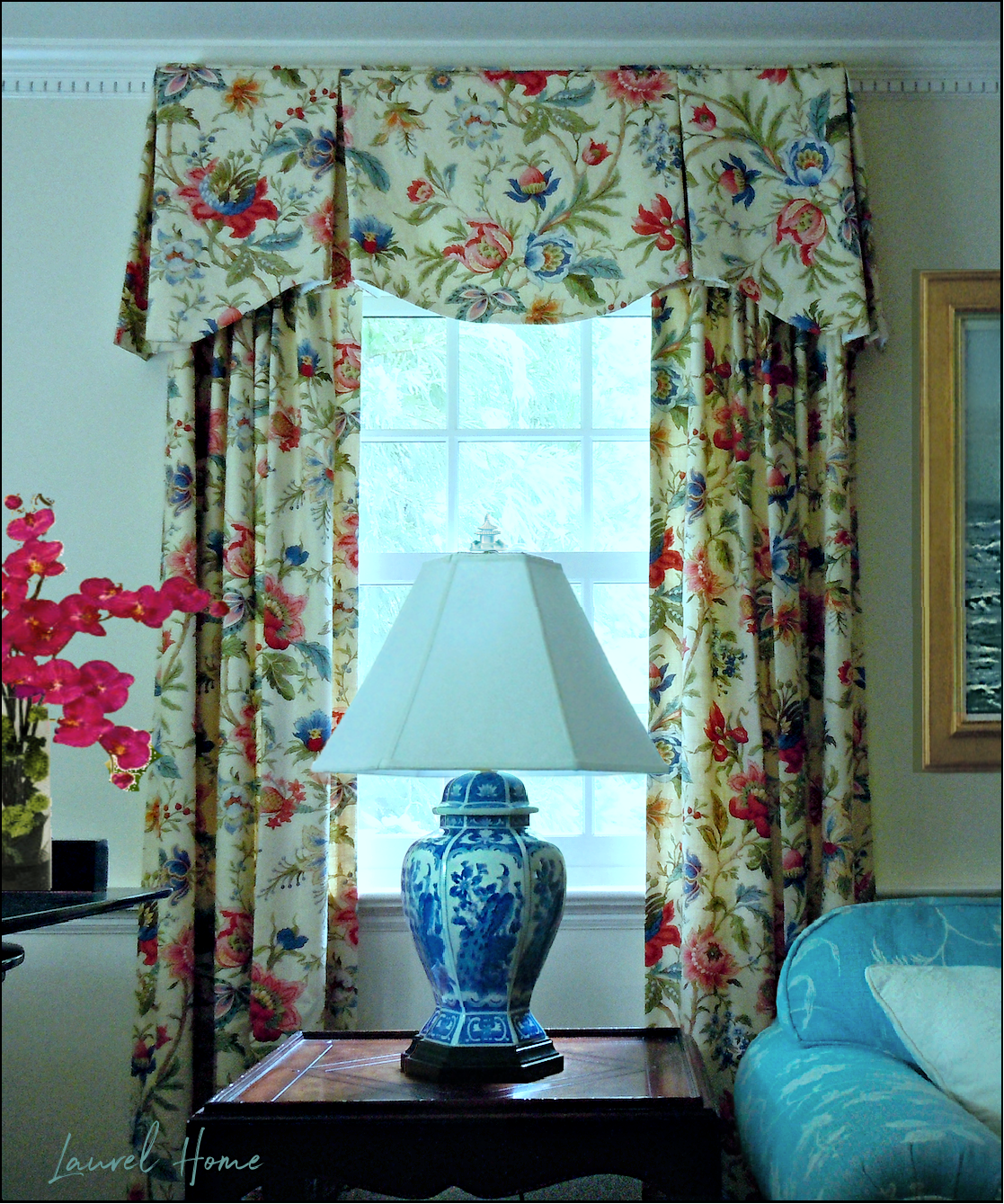
I made the templates for the valances out of newspaper.
In case you’re wondering. Yes, I doctored the image a bit.
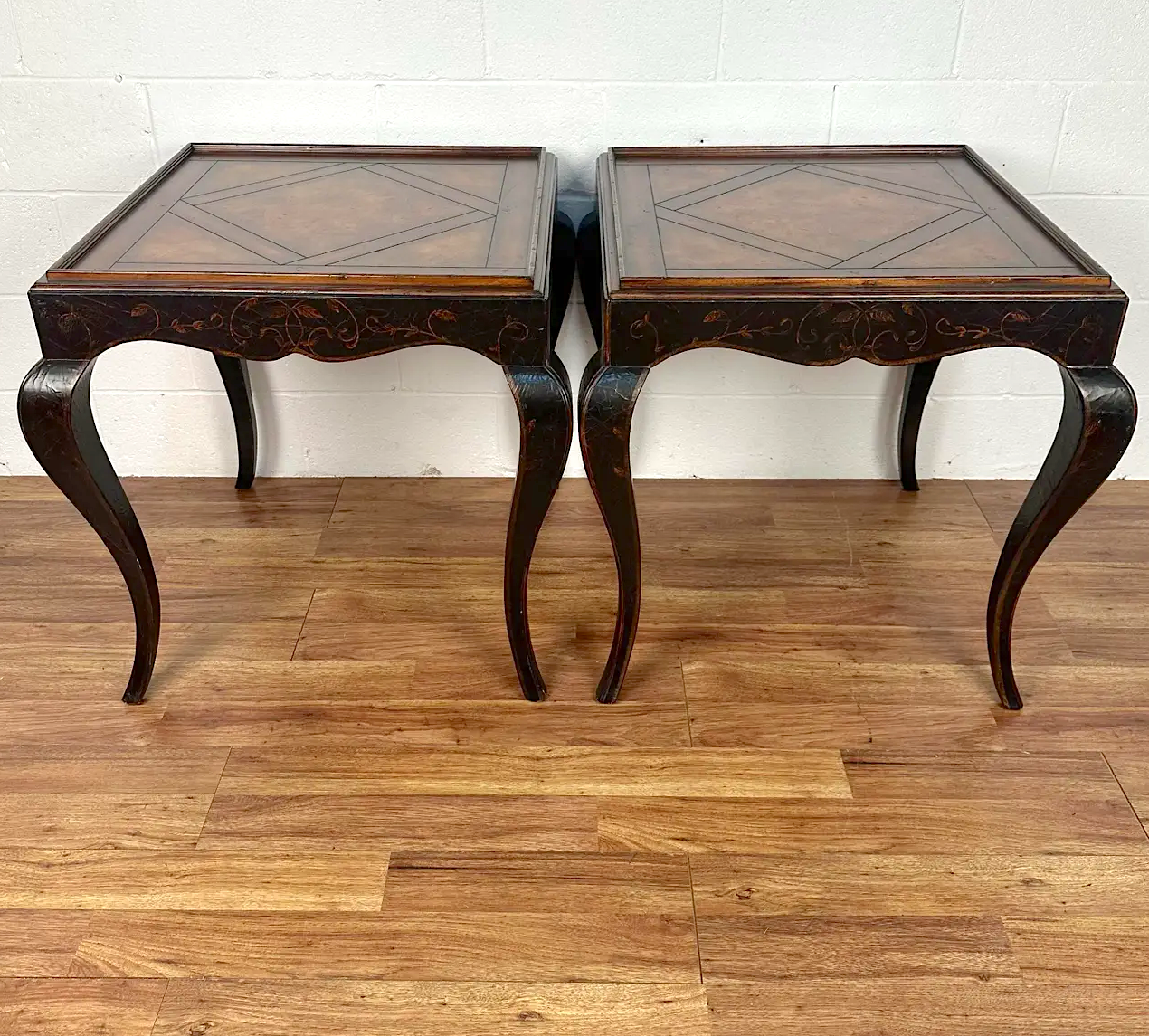
The sofa was an old camelback style, and we had it reupholstered in some rather expensive Cowtan and Tout with a jacquard weave. The end tables were very cool.
Omg! I just found them on Chairish. And the price isn’t bad. If you’re interested, I’d offer about $1,200 for the pair. I found another pair that someone is trying to sell for $2795.
Back to the Curtain Rods!
For the most part, because they are classic and stylish, I am only sticking with iron rods for this post about drapery hardware.
Incidentally, I didn’t know until several years ago, but what is commonly referred to as “wrought iron” is actually steel. I learned that years ago from a lovely company, By Hammer By Hand, who made all of my custom wrought iron (steel) rods and more!

Above is pretty much all I’ve ever used in the way of drapery hardware.
This consists of a rod and a straight pipe made of metal, and then painted either in a soft black or antique gold.
- Brackets to hold up the rod
- Decorative finials for the ends
- Rings (with hooks) to hold up the draperies or curtains.
(There will be a widget coming shortly, which will include most of this and other items.)
Let’s begin our Drapery Hardware topic with the Curtain Rods.
The rods you will most commonly find are 1″, 3/4″, or 5/8″ in diameter. The rods I did were either 7/8″, 3/4″ or 5/8″. That way, I could easily use a 1″ (opening) ring.
One thing I see a lot which is not a professional look is a ring that’s considerably larger than the rod. The ideal size for the inside diameter of a curtain ring is from 1/4″ to 1/2″ larger than the pipe.
What about the telescoping rods? (adjustable rods) Some of you may already know that I am not a fan, and here’s why:
Back in 1999, I had a client on a strict budget. So, we did the adjustable rods. Because one end is wider than the other, we spent two hours trying to get the curtains to hang straight. (ish) After that nightmare evening, I said, “Never again.”
Still, it isn’t the end of the world if that’s all your budget will allow. Please understand that everything I’m recommending is for optimal situations.
In addition, an uneven hanging issue can occur with custom rods, too. The possible reasons for this unfortunate result are because of the following:
- The floor is uneven
- The window is crooked
- The ceiling is crooked
- Everything is crooked and uneven.
I have a hard and fast rule in interior design, especially with curtain rods.

If there needs to be a center bracket because the rod is more than six feet long, I recommend putting that one up last.
What if the rod is still sagging, and you can’t drill a hole because it is too close to the one already there? OR, the hole will show?
Ahhh… well, then, you DO have a problem. If it’s for a client, here’s what I suggest.
First, go to where they keep their booze and pour yourself a stiff shot (or two) of whiskey. ;] ;] ;]
I don’t drink, but yes, it’s stressful as hell.
Okay, this is one of my favorite tricks; if you don’t want to or can’t make another hole, you can put a small piece of foam or toilet paper if you’re desperate. Just something soft that you can tape in place, between the rod and the bracket it’s sitting on. This will raise it up just enough, and it won’t be noticeable. Nothing worse than a drapery rod that’s sagging in the middle, AND also supported by a bracket.
Okay, what if holes in the wall are showing, anyway?
Please try not to do that. I worked with one installer on several jobs and lickety-split; he had put up the brackets before I could stand back and say, “Doug, ummm, the rod is crooked.”
Naturally, I got tired of this (and my clients complaining) and, thus, replaced him.
However, even with the most careful installer, mistakes are very easy to make. This is why your clients MUST go for a protracted, deluxe spa treatment while you’re putting up the curtain hardware and window treatments. ;]
Really, unless they are the super chill type, they should not be home. It is for the same reason that parents can’t be in the operating room if their child is having surgery performed.
So, now you have holes in your client’s walls.
After you’ve drunk the whiskey, you need to pray that somewhere, in the garage, basement, attic, closet– SOMEWHERE lives a left-over can of paint to match the current wall color. Your installer should always carry spackle with him in his tool kit. Have him fill the hole ASAP. Go find a hair dryer. Stand there like a nerd blowing the spackle dry. Dab the paint on very carefully.
Do not get paint on the window treatment. lol
Definitely, do not knock the paint can over. (Make sure the dog is nowhere nearby, as well.)
Carefully put the lid back on– tightly and put the can and hair dryer back where you found them.
End of story.
Hopefully.
Getting back to the rods. Yes, we are still only on the rods.
What matters is how the bracket gets attached to the wall. Of course, optimally, the rods will be screwed into a piece of wood known as a stud. Right? Well, if it’s a home built in the last 30 years or so, good luck with that one.
My experience is that new homes are typically made primarily out of cardboard and glue. This is not conducive to holding a metal rod with a ten-pound curtain hanging from it, along with an eight-year-old who’s using the curtain as a fortress.
Butterfly screws or anchor screws are your best friend, and while trickier to install will usually do the job.
In the 20 years I was taking clients, I went to every window treatment installation. And, whenever the job was finished, it was an incredible relief! There are so many things that can go wrong!
If you’re a designer and you find an installer who does a great job, I would treat him (or her) like gold. They are not easy to find.
I’ve never gotten into anything fancy regarding twists and other unusual shapes for the decorative curtain rods. Just a plain pipe.
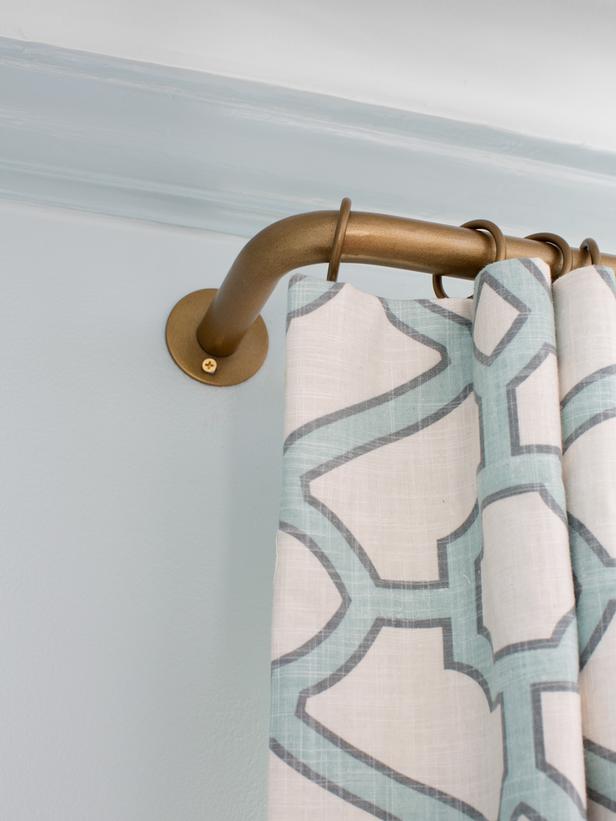
However, about 20 years ago, I began to see a lot of rods that had a return back into the wall. In other words, the rods curve back on themselves and go straight into the wall. They are now known as “return rods,” and they are everywhere. This makes sense because oftentimes, the finial, kind of gets buried, and the drape, ideal should make a 90-degree turn back to the wall.
The pipe can either be curved or at a sharp right angle, but it’s most commonly just a curve. These are called either return rods or French return rods.
Below, if the rod is straight, you usually need a finial unless you are doing a rod with a self-cap.
You rarely see it so that I wouldn’t get too hung up about that detail.
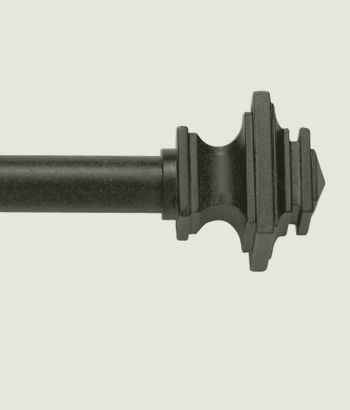
However, above is my favorite finial, which we fondly called the pagoda finial. Of course, you can do a plain ball, an acorn, whatever you like.
For the drapery return. The installer usually uses a little eye, screwed into the wall or a small picture hanger. Then a pin is inserted close to the end of the curtain and hooked into whatever was used. It’s not carrying any weight. It’s only preventing one from seeing daylight.
Drapery Hardware: Brackets
Brackets, of course, are the supports that hold up the rod. And, there are many, many kinds to choose from. Generally, the simpler, the better. There are so many to choose from, but the ones I generally did are in the graphic near the top of the post.
Drapery Hardware: Rings
Okay, a basic ring should have a loop on one end called an eyelet. What you do not want is what you are seeing below. That is a ring with a ring looped inside it.
On top of it, you can see the loop. When the drapes are pinned, the top of the drape should cover the eyelet and the hook. My rings are only a bit bigger than the rod, so there will be a tiny gap between the top of the drape and the rod.
There is a steel pin behind the panel, about an inch down from the top, but it might be more or less, depending on the situation.
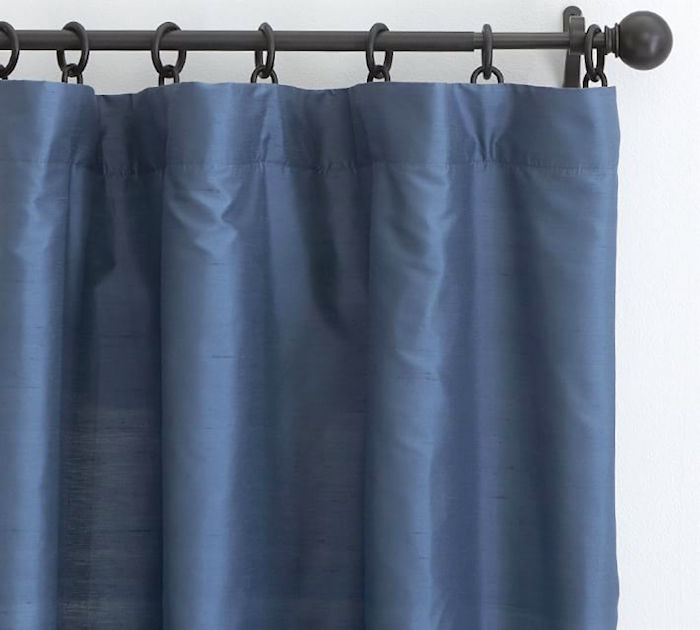
The pin must be placed so you cannot see the loop when the drapery is hanging. This takes a little practice, but eventually, figuring out the placement is not difficult.
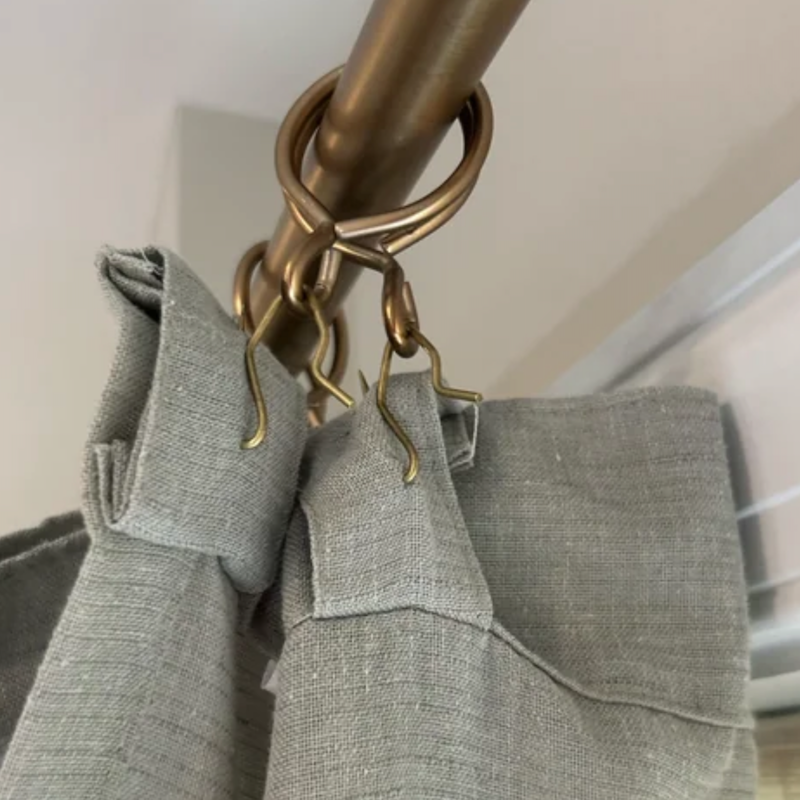
This poor individual knows this isn’t right, but reached out on a forum for help. Yes, the pinning here is not how it works.
Below is how the curtain should look from the front and the back.
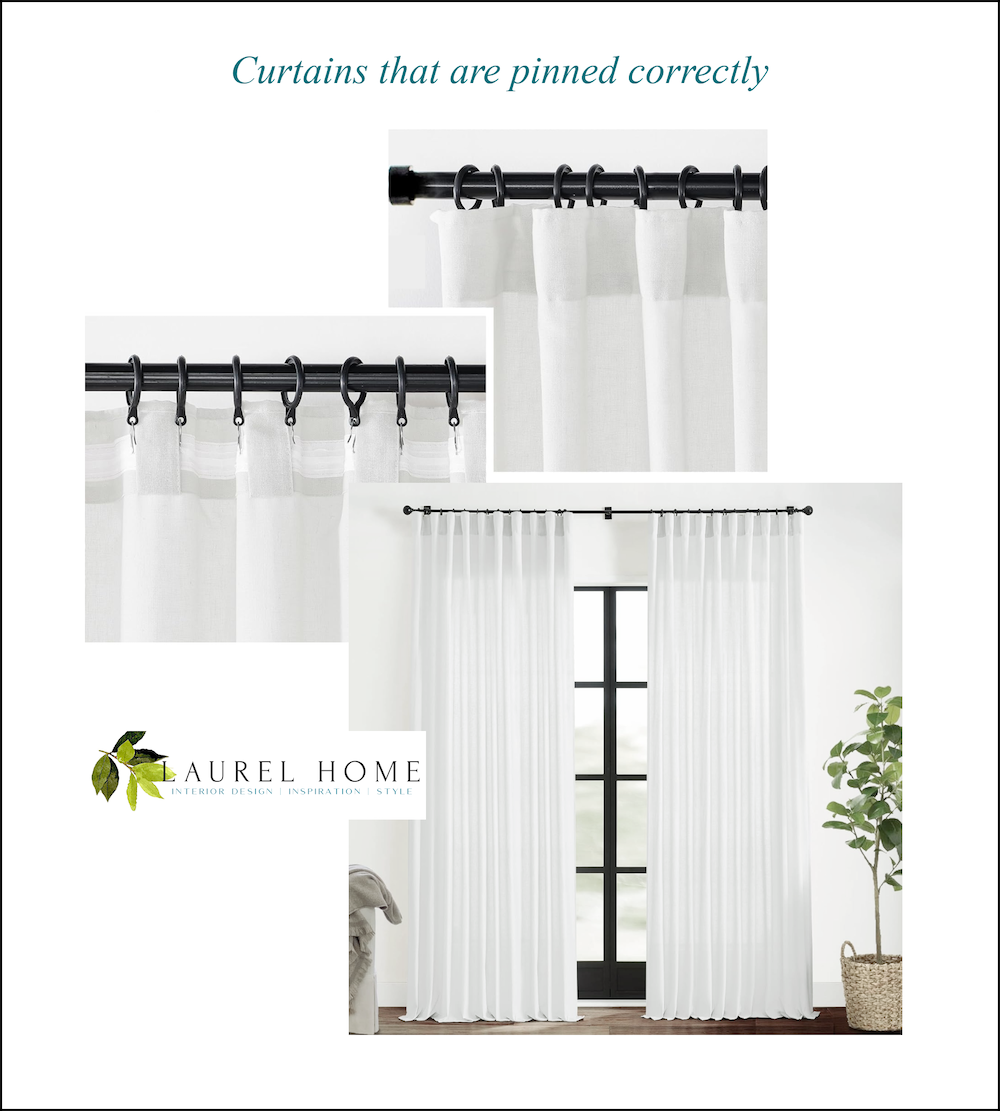
The fabric completely covers the eyelet, and the pin goes through every layer except the exposed front layer. It’s a bit tricky. And yes, I pinned many drapes, and my hands were screaming if there were a lot of pins to attach.
I have never understood the ring with a clip. Who wants to see an ugly clip? I guess it’s for people who can’t be bothered to use a drapery pin.
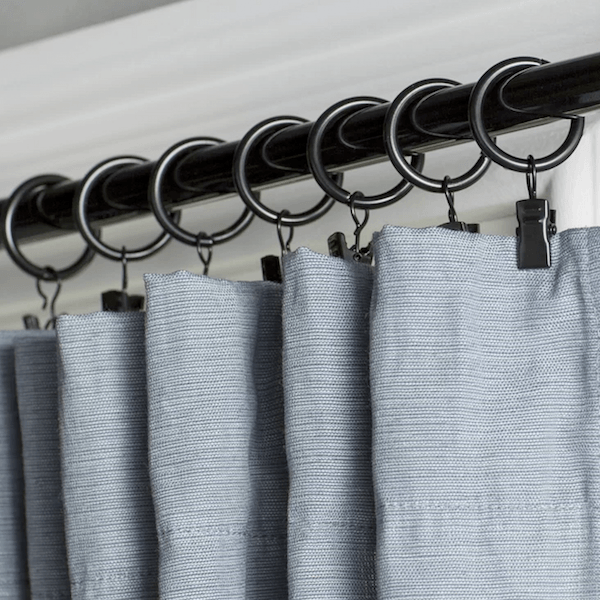
See what I mean? It’s like beetles are holding up the curtains. So bad.
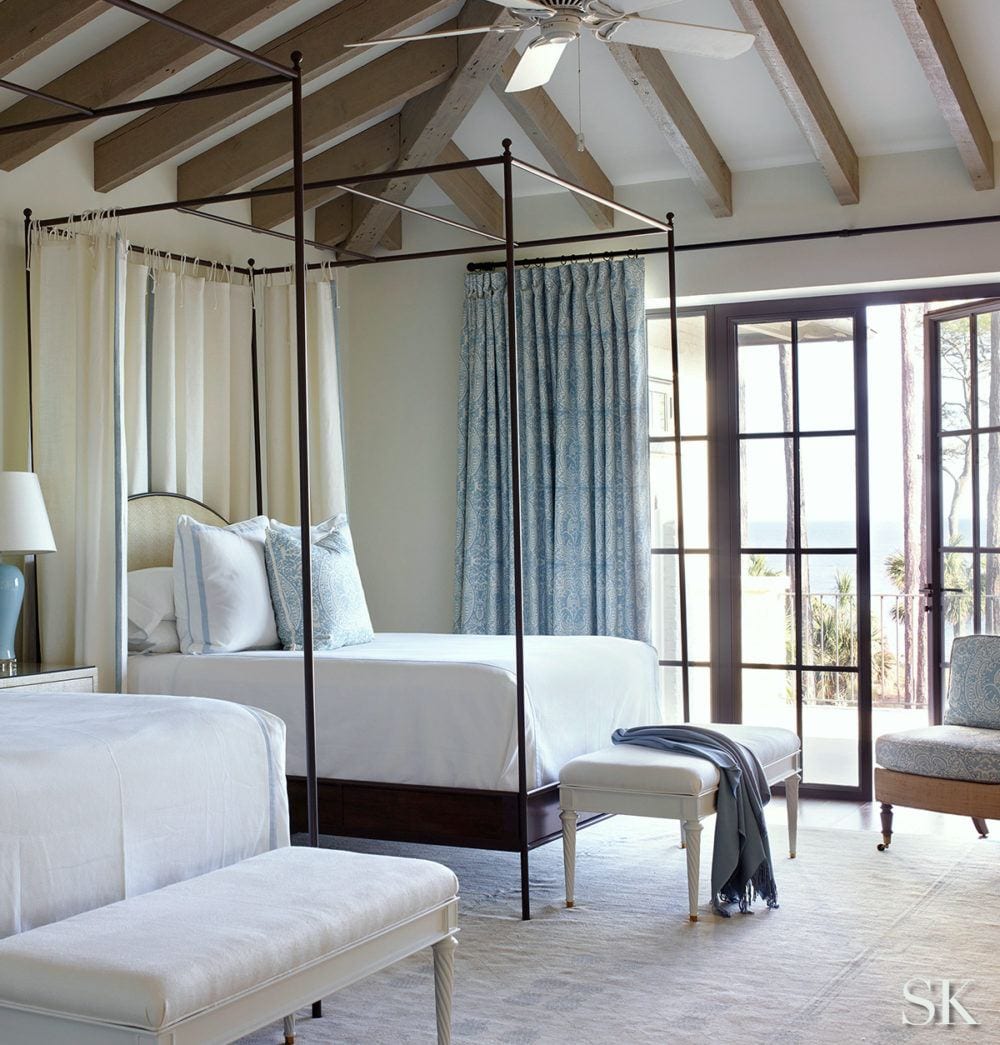
Above is another exquisite room by Suzanne Kasler. See, you hardly even notice the bracket in the center of the rod. The draperies are beautiful and cover up the loop at the bottom of the ring.
This image should go in the post about grown-up twin beds, right?
For more about rings and clips, please check out this post with great information.
Below is a widget with some of the products we’ve discussed and terrific sources for drapery hardware.

I need to end here for now because this is there is still a lot more to go. I’m going to turn off the comments on this one post until I do part 2. The reason is that you’ll either have questions or will remind me of something that’s already in part 2. The comments you’re seeing were after an earlier iteration of this post. 2/3 of the content is new!
Part 2 is coming up next!
xo,

*********************************************************
Part 2 Begins Here
Saturday March 4, 2026
Frequently Asked Drapery Hardware Questions + Related Issues.
Well, why do you need rings at all, Laurel?
That’s a great question. And no one can fault you for not knowing what the deal is.
Unless one is using a traverse or a ceiling track, there is only one way that professionals hang draperies and curtains that one plans on opening and closing.
If the curtain is stationary and underneath a valance, you may truss it up with butcher’s twine for all I care. No one will know but you.
Oh, I can see some of you looking very confused, and a couple of you look like you’re about to take off like the Artemis rocket. (Talk about steam!)
It is fine if you disagree; however, please consider if the reason that you’re disagreeing is that you’re assuming that what’s being peddled is optimal.
If that’s the case, then it’s important to understand that just because something exists in the marketplace– even if it’s prevalent and all of your friends have it– it doesn’t mean it’s correct.
Below is Exhibit A. Here we have the ubiquitous back tab pocket that the rod slips through.
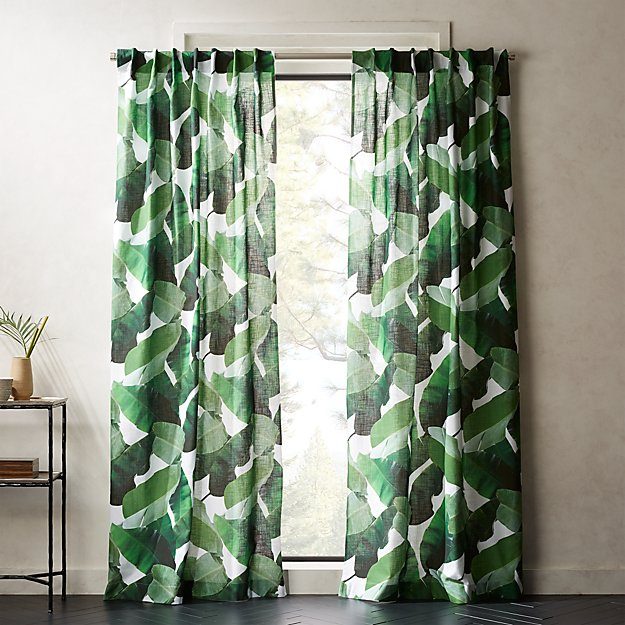
First of all, THIS looks bloody silly, IMO. The effect is that the curtain is stuck to the rod. All one can see is about a foot of rod in the middle and two little finials.
It is very strange to have the drape covering a decorative rod. I never saw this done until maybe 20 years ago. In addition, please note that they hung the drape below the window casing. They did it because of the ready-made length. They always make an 84″ length; the next length is 96″. Someone should get wise and make a 90″ length.
I have no objection with ready-mades. However, it is better to get the next size up and hem them rather than hang them too low.
Alas, I think it started when all the ready-made curtains became popular.
Ready-mades are a great solution when one can’t afford custom. But, rings are just one more expense. Perhaps the likes of Pottery Barn and West Elm realize that they can sell more window treatments if they don’t also have to sell folks the rings, as well.
But, have you ever tried to scoot fabric along a metal rod?
If you have, you will know exactly what I’m talking about. It’s very similar to trying to squeeze into your tightest jeans on January 2nd– right after taking a long, super-hot shower.
But worse.
Every time you try to open and close the drapes, you will be met with the most resistance you’ve ever known since your kids were 15 and no, they can not go to the Smashing Pumpkins concert on a school night.
And, that goes for tab-top curtains too.
Sooooo, if you know that you will never open and close the curtains, then I guess you could go without rings. But, if the rod is exposed, anything but rings is not a professional look. To drive the point all the way home. Please show me when Suzanne Kasler, Bunny Williams, or Victoria Hagan, et al., do drapes gathered around the drapery rod.
Never.
Still… if it’s temporary, you’re broke, and you need something cheap, then, of course, it’s absolutely fine to do everything I’m saying not to do. lol
And it’s fine even if you’re a billionaire. Really, it’s not a big deal. But, if you can swing it, grown-up curtains held up with beautiful hardware is the way to go.
Speaking of difficult to open and close, rings can be sticky too, especially if the rod is painted in a matte finish.
Never fear, another trick to make the drapes open and close super easily is to rub a little soap along the top of the rod. You can also use silicone, but never spray directly on the rod, and wipe it on outdoors in a place where no one will be walking. That stuff is super slippery. I never tried it, but a little beeswax from a candle would most likely work, too.
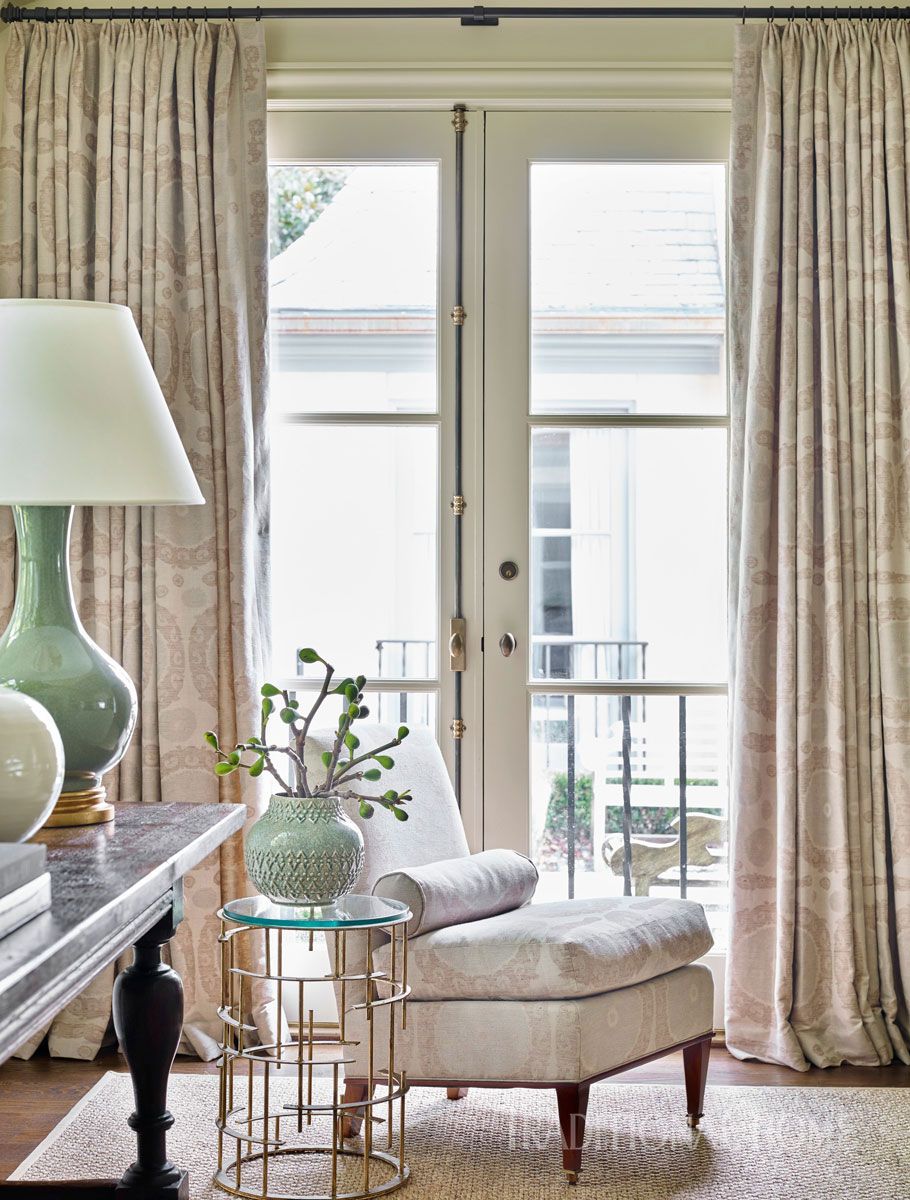
via Traditional Home (now extinct) ;[
Above is another beauty from Suzanne Kasler. Exquisite. That looks to be either a 3/4 or one-inch rod. The draperies are full. The header is covering the loop on the ring, and they are breaking about an inch or two on the floor. I very much love these discreet brackets, too. They are similar to the ones we used in Mary’s dining room.
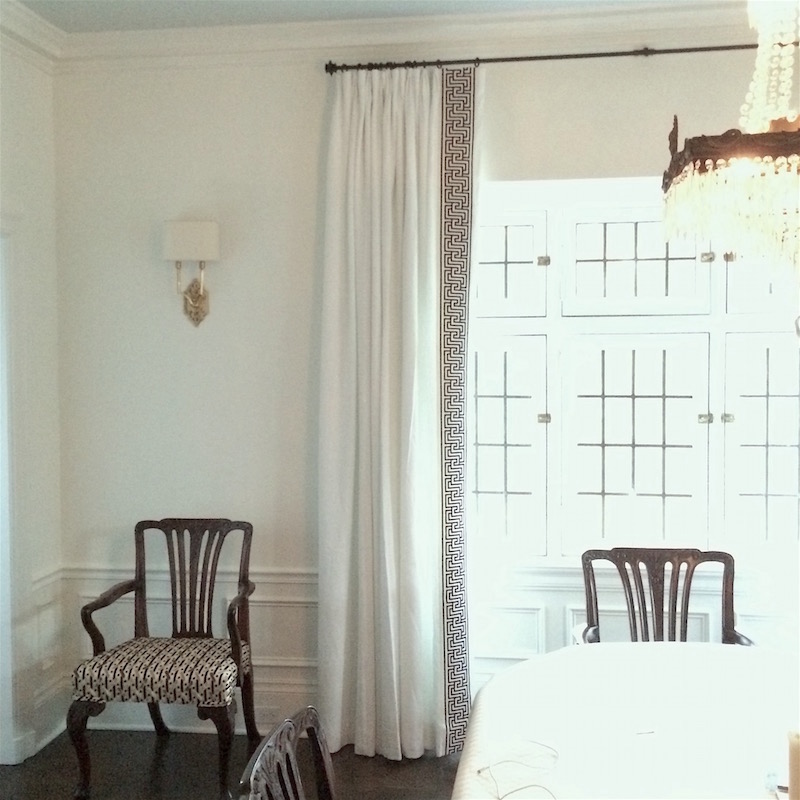
Laurel, aren’t they worried about the draperies getting dirty?
Not at all. They are too busy worrying about their kids getting into Princeton, Harvard, Yale… ;]
What about grommet drapes?
They’re not as bad as the curtains that are “stuck” to the rod. However, they’re not necessarily less costly than if you got a similar panel and hung it with hooks and rings.
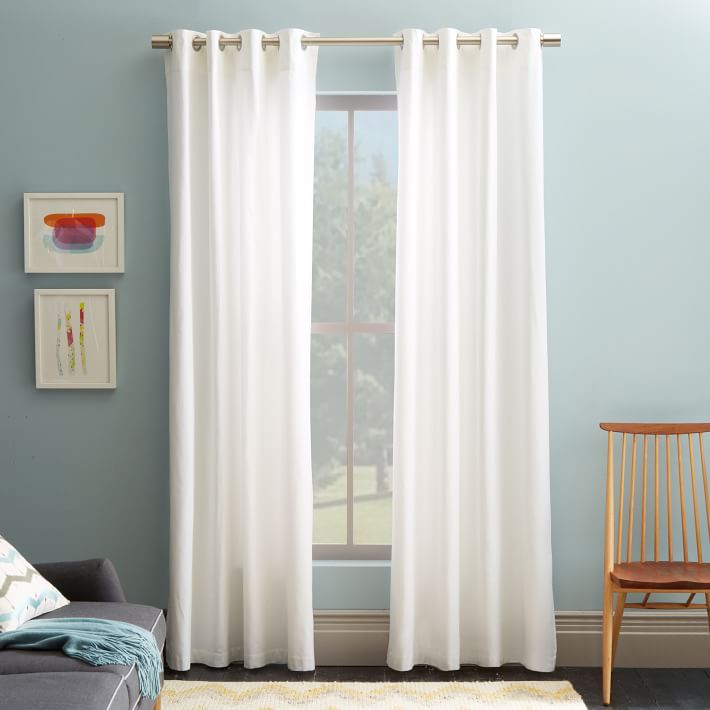
One of my favorite posts is how to make budget window treatments look expensive.
Laurel, what’s that funny-looking ring that looks like someone took a bite out of it?
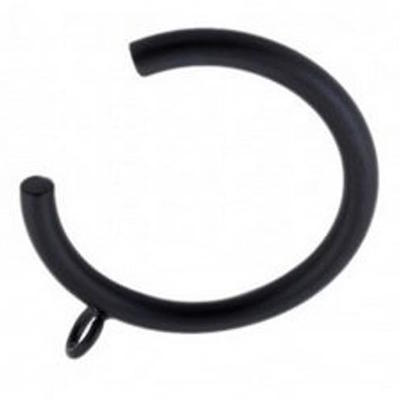
Ahhhh… that’s called a “C ring” for obvious reasons. The one above is from a boutique custom-drapery hardware company on Etsy called Lilly Max Decor.
What’s it for?
It’s for when you have a long decorative bracket that requires more than three brackets.
Normal rings won’t be able to go past the extra brackets. Therefore, some of the rings will need to be able to pass by those two brackets.
Or, sometimes, the curtains might need to open to one side or the other, and there’s one center bracket to contend with. There is also a special bracket called a bypass bracket. You will find an example in the upcoming widget.
Can you purchase rings and rods from different places?
Yes, you can. And what if the finish doesn’t match? If it’s already hand-painted, you can adjust the rod a little with some craft paint. But, unless the match is several shades off, it won’t be noticeable. I know this from experience. Also, some of the cheaper rods have a cheap-looking, almost plastic finish. It’s okay to repaint them!
Laurel, you haven’t talked about tie-backs.
You’re right. I haven’t. They’re lovely in a grand old home with 10-foot-high floor-to-ceiling windows. I always did holdbacks instead of ties. Still, they’re a bloody pain in the arse to install. I always struggled to get them to hold back the drape.
You also haven’t talked about traverse rods and the treatments that get attached to a slider thingy in the ceiling.
I did traverse rods for the Carsons with the shaped valance above. The slider in the ceiling is strictly for contemporary homes. Usually, something is covering the mechanism, but not always. I think those are cool with a luxurious semi-sheer wool fabric. However, it should never be hung in a hot, south or west-facing sunny window.
One last question, Laurel, about the drapery hardware/
Okay, fire away.
How do you know how high to hang the rod? Or rather, how do you know how long the draperies should be?
Please refer back to the window treatment post, where we go into that at length.
In closing, I know some of you are going to complain.
“But I have drapes like the ones you said I shouldn’t have, and I love them.”
That’s okay. These are general rules for elegant window coverings. And of course, if you have a beach home and you want to do grommets or clip-ons, that is totally fine.
However, unless you’re:
- Broke
- Between the ages of 20-35+++
- And your idea of a home-cooked meal is a package of reconstituted ramen noodles laced with sriracha… ;]
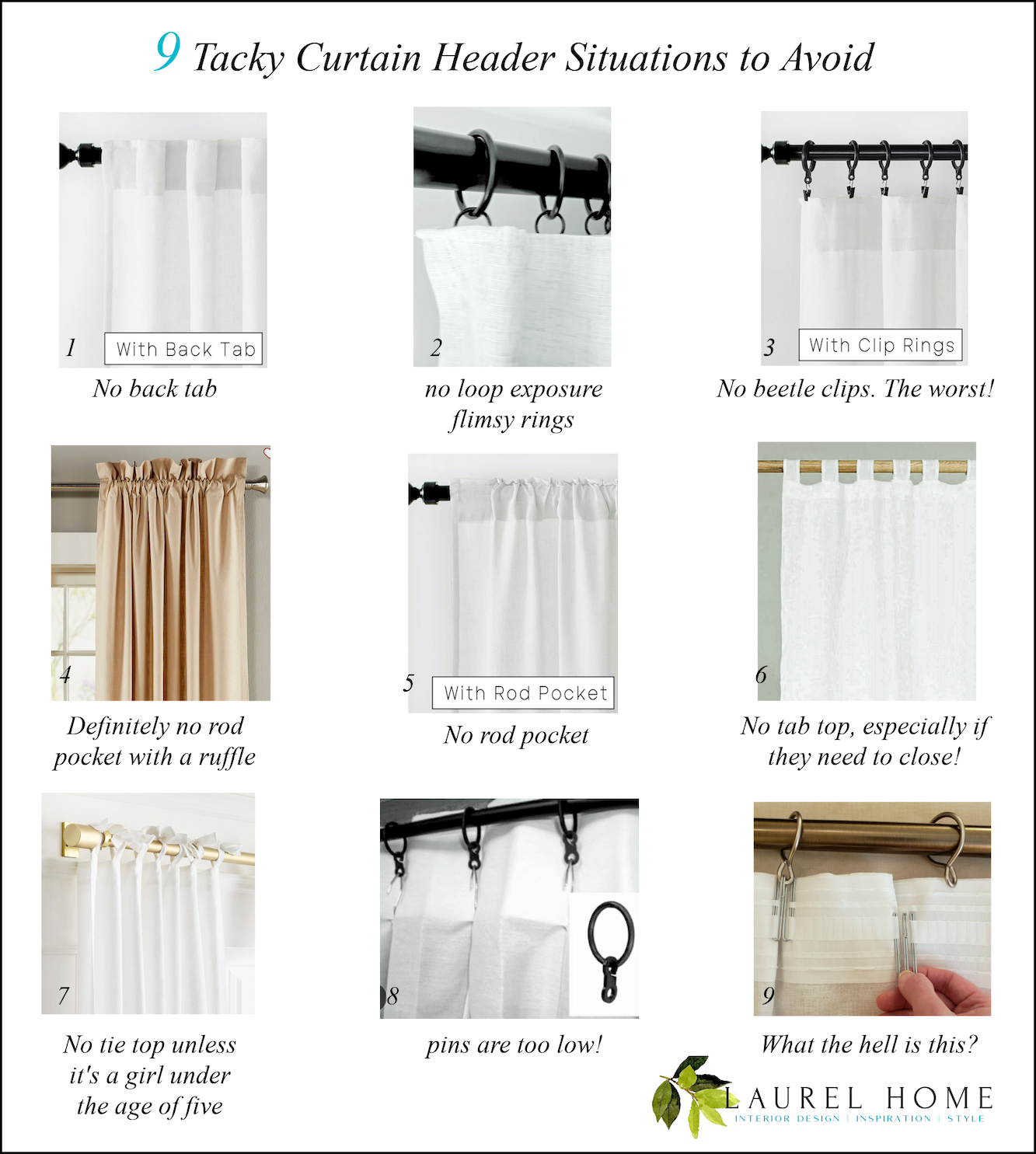
Then please avoid the following curtain situations.
As for the color of the rods and rings. 80% of the time, I did antique black. The rings were plain black, and it didn’t matter. The other 20% of the time, I did antique gold.
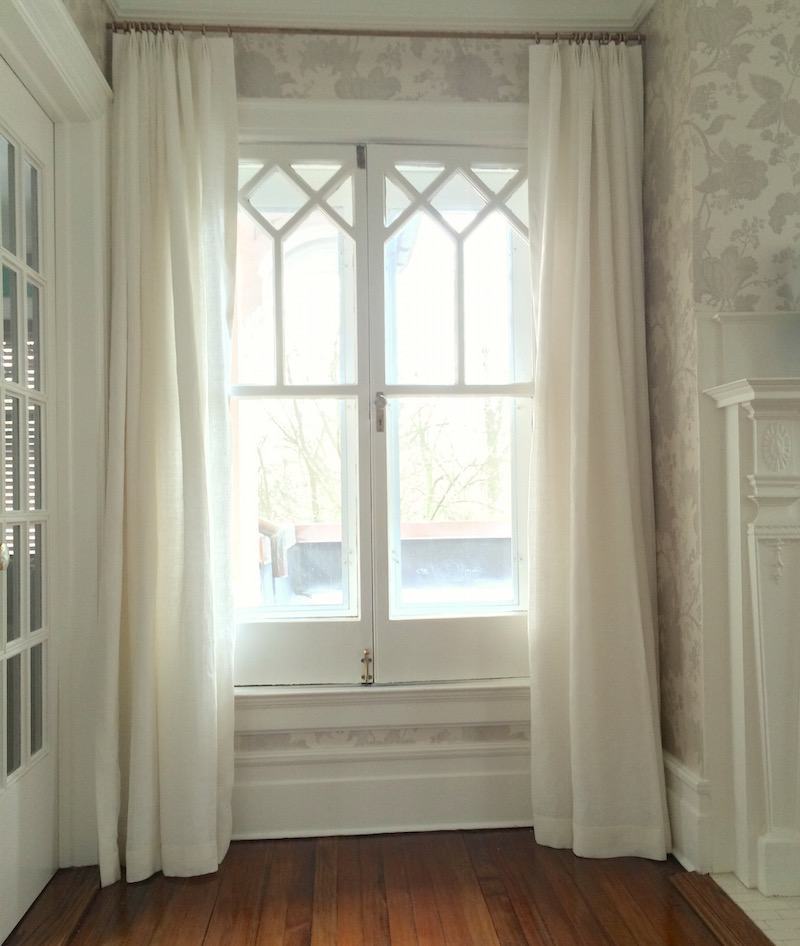

Above is a job I did in Katonah, NY, in 2010!
This is a panel and a half.
The bottom is a whisper above the floor. You cannot see any sign of an eyelet or hook. This was a 5/8″ rod. Very skinny! If it were today, I’d probably do a 3/4″ rod.
One thing I forgot to mention is that the last ring should go to the outside of the bracket. This is so the drape doesn’t skootch too far from the end of the rod.
Below is the widget from above. If you skipped ahead, I have added onto it for today.
Of course, there’s more.
I have turned the comments back on, so please ask any questions.
It’s a surprisingly broad topic!
You might also enjoy this post about different drapery styles shown in 17th – 19th-century art.
But, have you seen these so-called easy-to-install brackets? They don’t put ANY holes in the wall.
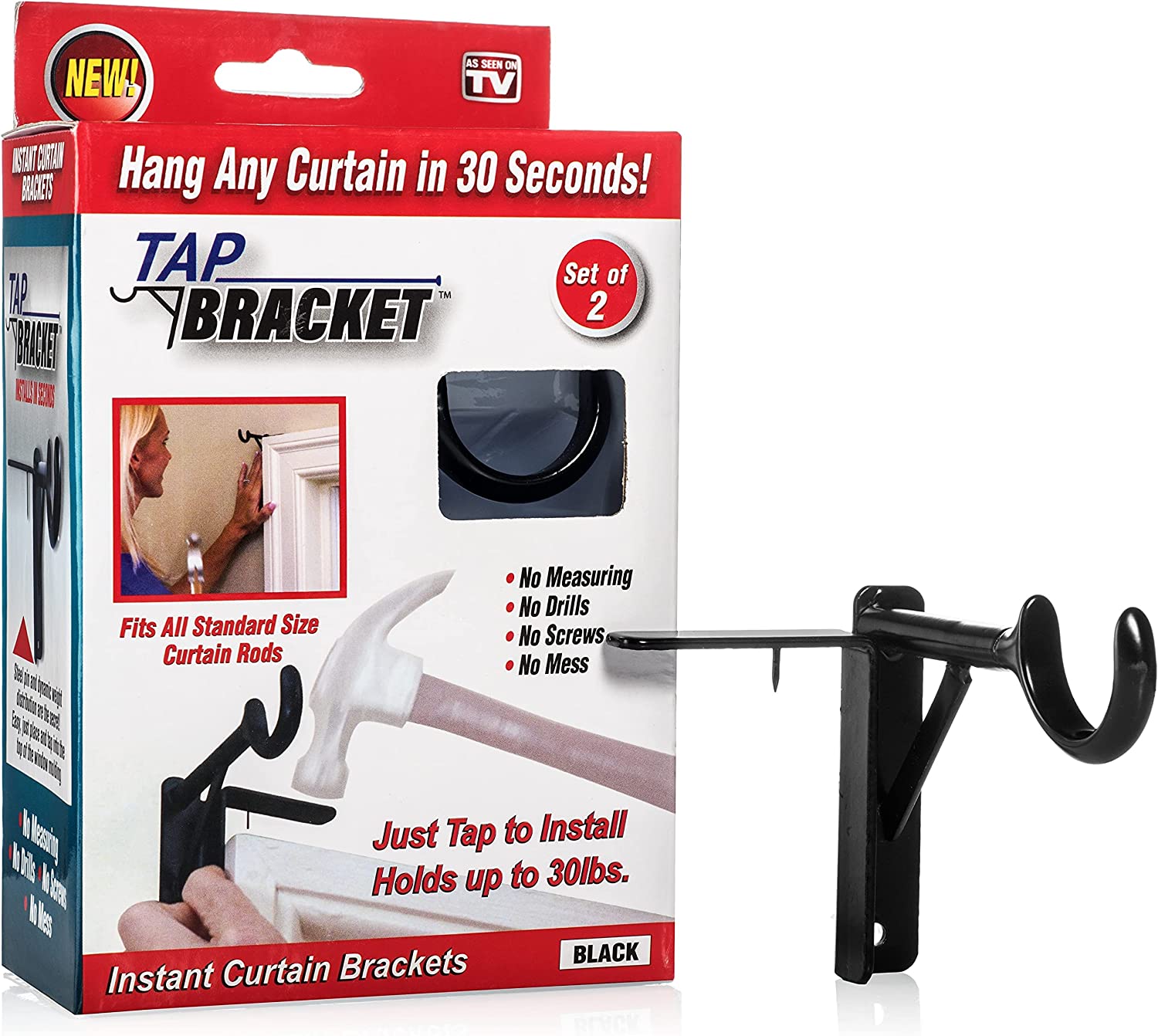
They’re called Tap Bracket. (You can see them here.)
They claim that anyone can hang curtains in 30 seconds or less!
Really?
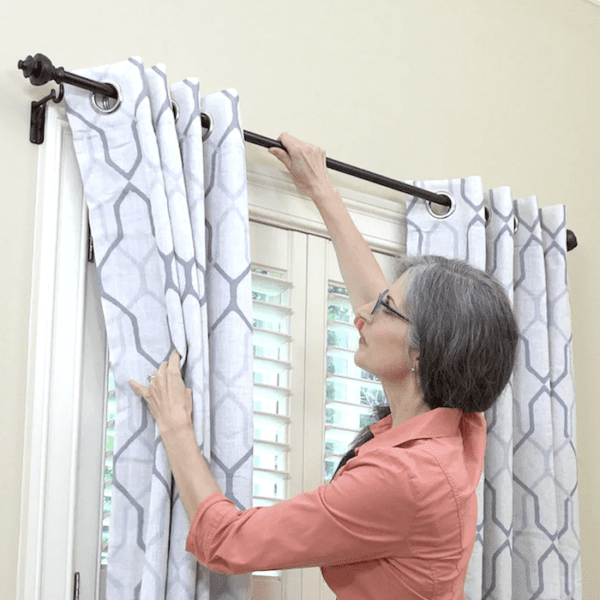
Below is a video that tests them to see if they really work.
Oh, one more I just thought of regarding curtain hardware.
This is a terrific post if you have a Bay Window. the Best Bay Window Treatments and Measuring Guide.
xo,
***Please check out the newly updated HOT SALES!
Everything is up-to-date. There was a big spring edit for this Holiday Weekend!
Also, if you’re doing some shopping on Amazon, please click this Amazon affiliate link or the graphic below.

Thank you so much!
I very much appreciate your help and support!
Related Posts
 Are Green and White Rooms Trendy or Passé?
 Everything You Need To Know About Classic Woven Wood Blinds
 21 Common and Hideous Interior Design Mistakes
 The Horrid Gray Trend – Is It Finally Over?
 The Best Upholstery Fabrics For Pets and Slobs
 The Magnificent Front Doors of Beacon Hill
 How To Avoid the Clash of Formal and Casual Furnishings








107 Responses
If “Beetles” are going to be holding up my draperies, I would like to request Paul McCartney. I don’t care what it costs, just add it to my AmEx. 🩷
Hi Laurel,
Here’s a tip…when installing a French return rod, make sure all the rings are on the rod before screwing it into the wall. Don’t ask how I know. 🤦♀️
And when I realized seeing the center bracket bothered me I painted it with some leftover wall paint.
Have a great week. 😘
I love this post, Laurel. Thank you. I just want to share a few things I’ve learned. 1) Lucite anything scratches every time you look at it. Lucite rods are best for stationary drapes and be careful as you place the rings on them so the lucite doesn’t scratch. For people looking for something modern that won’t scratch, ADR (formerly Antique Drapery Hardware) makes some beautiful polished aluminum “zip” (manual traverse) rods. Second, some companies, even ADR, make bamboo rods. While these seem like they would be perfect for Chinoiserie drapes, the rods — which aren’t cheap — bow within weeks of install. Thinner wood rods can also bow, even with plenty of brackets. Some manufacturers recommend “spinning” wood rods half a turn a few times a year, but who wants to bother with that? Finally, someone asked about white rods. Intellectually, it seems like white rods should look nice with white curtains in a shabby chic room, but in my experience, they don’t. The eye needs some level of contrast. As you said, black or gold is usually best for rods. Rods painted to look like walnut or some other wood can be nice in some spaces. Silver can work with some darker curtains. I’ve seen decorators specify beige or other painted rods on super wide windows, and they don’t necessarily look bad, but I usually think that something that looked natural (like iron or wood) would have looked better.
Cafe curtains for window above sink??
Under the 9 tacky header situations to avoid, the last picture, “what the H is this?” — that is pleater tape and the pins used with it. Pleater tape provides nice stiffening and finishing at the top of a panel. It has vertical pockets in it to insert the special drapery hooks that form French pleats but it is much easier to use than the intimidating math to determine how much fabric should be in each pleat and then the distance between pleats. Easy to browse the interwebs for instructions, tutorials, and supplies. Not as crisp as custom draperies but much much better than tabs, ties, and back tabs.
I recently lived in SF but my long time decorator friend was in NJ. We selected the fabrics together, I measured, then she had my drapes done at her workroom but then I had no one to install on 10 ft high windows. Called my local Calico Corner shop and made an appointment with a very nice sales woman there. I brought the fabric samples and she worked with me to select the hardware (beautiful custom but not outrageous) and she gave me the name and # of their local installer. He was not only very good and reasonable, but just came back 4 yrs later when I was moving again to take everything down for me! A gem and a gentleman.
Hi Kathleen,
What a great story! Thanks for sharing. I’ve worked with some fantastic installers, and they’re invaluable!
Hi,
Love your blog. Is it too much to have solar shades for windows in family room. And roman shades on a kitchen window and romans and curtains for dining room. I have an open floor plan.
Thank you so much
Hi Ilene,
Thank you! Without seeing what you’re talking about, it’s impossible to know.
I Laurel.
Love all this info. I am, however, waiting to see your decorated closet as it sounds to be a reprieve from all the moving and “waiting” for your true reveal at your hopefully “forever” home. Stay strong Laurel and know the road ahead is paved with good outcomes and challenges. As we know, the challenges are what make us grow.
We are all here (and hear) for you.
Be advised, if store bought draperies are being shortened, please do not take them to be altered and say, for example, shorten these 4 inches. Both panels rarely match in length, and almost always, one side of the panel will differ from the other. It does not matter the price point, either.
This comes from a retired seamstress that has experienced this headache.
I’ve made my own drapes numerous times and I can tell you that no matter how much you are charged for custom drapery, it isn’t enough. It is bloody hard work from start to finish. My first set of 6 were lined and of a very expensive Kravet fabric that looked like dupioni silk. I have a very small sewing room and managing yards and yards of fabric is not easy or fun when you don’t have the 10′ x 6′ foot work table that most workrooms use. My last experience was with linen that was so heavy I couldn’t even think of lining them because carrying just one unlined drape was backbreaking. Calculating yardage involves more math than most adults will face in their lifetime and has caused many a prospective sewist to throw up her hands and say “forget it”. I like math but figuring out finished length has always involved several trials because after hanging, the drapes usually grow by an inch or two which has left me in tears more times than I can count. My advice is to thank your lucky stars if you have someone to guide you (like Laurel) or to make them for you.
I don’t think it is a serious grammatical error, but to save someone possible embarrassment the difference between drape and drapery is drape is a verb, drapery the noun. The fabric you chose drapes beautifully and will be elegant draperies. I was severely chastised by my mother-in-law – over a century ago, when I complimented her on the beautiful drapes in her living room. There are some rules of grammar you just never forget!! No matter how unimportant.
jeanne
First, I hate grommet drapery with the heat of 1000 suns. But that’s me. I also have no problem with clip rings in a more casual room. Lastly, Traditional Home is most certainly still being published -it is now a quarterly to which I subscribe.
Thank you for another fabulous post, Laurel. Sometimes when the news is bleak I return to some favorite posts and enter a happier state of mind. Making the world a beautiful place is really what matters and you are a genius in inspiring your readers with the details of how to make that happen.
I know you don’t love tab curtains, but have you seen Carolyne Roehm’s tabbed curtains in her Charleston house? They are fixed and quite formal – gorgeous fabric and ties/bows securing each tab. Rather stunning.
Good luck with your move – can’t wait to see the unveiling!
Terry
Thank you, thank you for all of the details! I have a question about cafe curtains… I grew up with them in the kitchen am and seeing them again. They might be perfect for my one kitchen window, in a sheer white, with pleats. What do you think? A fad???
We have traverse rods for linen curtains on two large banks of windows. They look good open and closed. Much easier than the wands we have for similar curtains in another room. Sometimes I don’t get those opened evenly.
Custom curtains are beautiful and worth the expense. But it can be hard to find a workroom, for amateurs like me, working without a decorator. Let me put in a plug for The Shade Store. Not inexpensive, but they do beautiful work and have great service. Had some issues with a Roman shade, purchased from them seven years ago. They sent a repair person to my house within days. No charge to fix.
Thanks for your reply!
Hello! Thanks for all the wonderful information you share on your blog. I have a question about curtain/drapery hardware in bathrooms. Should the window curtain rod match the finish of the shower curtain rod? Thanks for taking the time to read my question.
It depends. Sorry, there are too many variables. Over-all, I would say no, it does not have to match, but in the context of the design, that should make sense.
Travis, as Laurel said your drapery should overlap in the middle, even with a center bracket. You may be able to move the drapery pins in to create a small overlap. The best choice for drapery hardware for a functional treatment (especially a heavy one like velvet), is a Decorative Traverse Rod. But you are not out of luck. There is a tape that you can put on top of the rod, although I’ve never used it, so can’t speak to it’s usefulness. You have 2 other options. Take some Pledge and spray it on a rag, then rub it along the the top of the rod. This works really well for Wood Rods. If you have a Metal Rod, get some liquid silicone and do the same thing – spray on rag and rub all along the top of the rod. Do NOT spray anything directly on the rod, because you might accidentally get it on the draperies. You do not want that! Good luck! I bet your velvet draperies are beautiful!
Maybe it’s just me…. guests complaining about curtains and getting adamant that the installation is the problem?? Yikes.
Hi Laurel! Thanks for all the great information regarding getting your draperies installed correctly. I do have a few other questions that I am curious about. Is it acceptable for an expensive drapery install to have a small gap between the two panels of drapery where they meet up in the center with or without a center support bracket? Is this unavoidable? For heavy drapery with blackout lining have you ever used the tape that goes on the top of the rod to make the heavy drapery slide more easily? I had guests recently who were complaining that they couldn’t close the draperies completely and that the rings slid too sluggishly over the drapery rod. They were adamant that the installation was a problem. For the record, I picked the fabric, the lining, and the French return rod so a big part of the problem may have been my choices! The drapery wand is rather heavy and not infrequently comes off because you end up lifting up on the draperies slightly to get them to slide more easily. Those are my drapery issues and perhaps they are unavoidable? I am hesitant to contact the installer because open and closed the draperies look beautiful and I figure that perhaps this an issue with all heavy draperies and unavoidable?! You always have great advice and of course if this is off topic please don’t feel you have to even respond or post the question! Always greatly appreciate all your advice and wisdom from the world of design.
The draperies should not only meet up, but actually overlap by a few inches. I have not heard of the tape you’re speaking of, however.
Laurel , I have read every curtain post and realize how foolish I was to think I was going to hang curtains in my home. My problem now is a window with a radiator directly below it. I have no idea how to dress it!
Roman Shades are what I usually do in cases like this.
First of all, I could never hate you! That being said, thank you for sharing the pictures; the rods look great in this application. I’m noticing that lucite rods look best when there is a very pretty paint or wallpaper showing through them — they have the ability to almost disappear.
You’re welcome Patti! I can’t see what what said before because I’m in the answer comments area of my admin dashboard.
Hi Laurel,
Well, now I’ve learned something new. I had never heard of a C ring before. I can certainly see how functional they could be.
Does anyone ever use a traverse rod anymore? I remember when I was younger having one above some sliding glass doors. And I would pull a cord that was along the side of the window treatments to open & close them. It allowed you to open & close your draperies without needing to touch the fabric.
Hi Mary,
Yes, they make them, both the decorative kind and the kind that you don’t see. I used those once or twice if we did a valance.
I made and installed all of my own drapes (I swear they are nice, lined and interlined, euro pleats but they just kiss the floor because I am also the maid), and I actually ordered wood kirsch rods online partly so I could easily cut them to length (just need a hand saw). Our house is extremely crooked which will be charming in 75-100 years, and I actually installed the hardware first and then measured for the drapes. There is one window where the right panel is a full 1/2 inch longer. A good option maybe for DIY-ers. I am still totally stunned by how expensive the curtains in our house were considering I bought all the fabric from online discounters and I sewed and installed everything myself. I have convinced a few friends that their outrageous curtain quotes are not a rip off. Anyway your other curtain posts were extremely helpful for understanding pleat types and widths, thank you!
Hi Catherine,
It’s true. Nobody is getting rich off of window treatments. At least, I don’t think so.
Thank you for all of the really great info in one post! I tend to call short draperies “curtains,” but I can see the light vs. heavy. Or maybe lined vs. unlined. I love the French return rod! When I have used the cheap expanding rod, I buy 2 of them and use the two large ends with one skinny in the middle. That way you only have a small amount of the skinny rod in play and can easily adjust the center support to hold it. But the majority of the drapery panels will be on the same diameter rod. Thanks again for this great post!
Yes! Thanks for giving that info on the return. It makes such a difference.
Such an informative post! How do you recommend choosing the hardware finish/color? Should you consider the color of the room or the style of the room?
Hi Maureen,
Good question. It’s too many factors, but most of the time, I did a soft black. But, sometimes if I wanted a lighter or more formal look, we did antique gold.
Amazing topic and research, in my list of your hits! My favorite blog post is designers you would like to hire. And anything about decorators from hell or clients from hell. I’d love to read fresh versions of them. I know that is not safe topics for the writer, but I injoy reading them as a reader and find them so educational, fun and just great! Personally, I’m interested in a topic such as why A-list decorators think they’re so unique and charge $$$, what do they bring to the table? They all shop at the same sources all the time. And why decorators never have the list of services on their websites? I guess when they come to nail salon, they would demand it. Or at a restaurant too. It immediately make them look a bit dishonest. Like they’re hiding something. And they ask what is your budget immediately… like come to nail salon and depending of what clothes you wear we charge you accordingly. The same time MRI in a hospital costs… you know how much and no one is complaining that it’s a rip off. lol
Hi Lisa,
There are fresh versions of the decorator/clients from hell posts and they are all next to each other. Definitely within the last year.
OMG, what a comment I posted. I just read it;] Laurel, please forgive me. But your answer is great anyway!
In high school and college I worked for a lady who had a drapery workroom. She went bonkers if someone said “drapes” instead of “draperies”. She explained that “draperies” is a noun, and “drapes” is a verb. Lest her ghost should reprimand me some 40 years later, I use them correctly to this day!
Oh, too funny Gail. Well, in this day and age where every verb has turned into a noun anyway. (And vice versa) I mean if you GOOGLE it, I think that we can ARCHITECT a solution before the big REVEAL.
And, there ARE words that are both nouns and verbs. EScort, esCORT IMpact, imPACT INcrease, inCREASE INsult, inSULT – I looked that up. I’m not that clever.
Therefore, I wouldn’t GUILT yourself too much over the use of drapes instead of draperies.
This is the best and the most in-depth post about drapery hardware I’ve ever seen! Laurel, I’m wondering if you doing your own interior design and want some help…say from another famous designer (for example, Suzanne Kasler), would it be acceptable for another designer to work with you? Do designers work that way or they prefer a regular client? In terms of fees, how would you ask someone like her?
Hi Val,
I’m not sure I’m understanding the question. Really, there should only be one head chef. Of course, I’ve consulted with designer friends on occasion. But, it’s a reciprocal thing. Or, we share sources. I have a friend that I met in design school back in 1988 and we used to do that all of the time. And, sometimes even send each other clients that were better suited (maybe) to the other. We had very different styles.
Some designers who are well connected might get the work and then hand it over to another designer and take a cut of the profit. How does that work? Well, of course, they are honest about it. It can only work if the two designers have the same aesthetic. That is different than hiring designers under your own umbrella.
I don’t know if that answered your question or not.
Hi, Laurel,
I have a question regarding grommet-topped curtains covering a long span with a rod requiring support brackets. What’s a girl to do? I have ready-made Pottery Barn Payton drapes spanning the entire length of my wall, which are driving me nuts because, predictably, they get hung up on the support brackets required by the length of the rod span. What would be the correct method of hanging a grommet-top drape over a long span? Should I surgically remove part of the grommets and drape so that they form a c-ring as required? Or, is this type of ready-made drape just not appropriate to a long span. 🙁 Hind-sight is 20/20, but I’m not planning a do-over. They look great when closed!
Hi Susan,
Well, I can’t see what your sitch is. I don’t think you could turn the grommet into a C-ring because it’s part of the fabric. With a C ring, the fabric is underneath the ring. The only other solution is to divide up the panels, so that none of them are required to cross over any of the brackets. But, again, I don’t know if that’s possible with your configuration.
Hi Laurel, I LOVE your blog, it is quite literally the best source for me on just about everything I come up against as a designer. Some stuff I learned the hard way, but so much better to learn from your experience!! One question I have: do you ever find that measuring length sometimes isn’t enough? I have found that, depending on fabric and length, ready-mades fabric can pull down a bit and screw up all your length measurements (most of my client’s kids go to community college). So I always have my installer hold up the drapes on the rod and bracket before marking the holes for the bracket screws (poor guy!) since I prefer hanging between 1/2 to 1 inch above the floor. Any better ideas rather than ruining my installer’s arms and good opinion of me? Amen on the extending rods!! Hate them, measuring is impossible, straight is impossible, can’t pull a ring over them, arrrggghhh!!
Hi Dee-Dee,
Well, when we are on site, we take one panel and lay it on the floor and then one of us takes one end of a front and the other takes the other end and we make sure it’s nice and taught, not pulling, just perfectly straight and then take our measurement. But, yes, sometimes, the brackets still didn’t end up in the right spot. And sometimes, it was in one of those “cardboard” houses. The sheetrock just crumbles away. No wood. No wood anywhere to be found!
But, we always got them up and secure. As far as I know, no rod ever came down unexpectedly. knock wood!
Any thoughts about hanging curtains from the ceiling? I know that Bobby McAlpine and his crowd do it all the time. I have a bedroom situation where we would like curtains but pockets for automated sun shades prevent us from hanging them on the wall.
Hi Annie,
I did it once with a rod. That one was difficult for the guys to install, but they did it. We used the bracket that has a loop and the rod was in two pieces which screwed together. It was quite dramatic because the ceiling was also quite high. I know that there are some posts here that show drapes hanging from a hospital track on the ceiling. So, to answer your question, yes, it’s possible.
This post illustrates exactly why I find even thinking about window treatments so difficult. They are sooooo complicated.
We rented a rustic house here in the mountains that had no window coverings. It mostly didn’t matter because neighbors were far away.
However, I tried to put up curtains in the living room and they looked awful with the strong rustic architecture in that room. The curtains actually muted the architecture! The minute we took them down, the room looked right again.
On the other hand, when I put curtains up in my bedroom, they improved the room amazingly.
Hi Lorri,
That’s interesting. For some jobs, there was a question whether window treatments were necessary. So, I would say, let’s do everything else and see how it is. It was about 50/50. One thing I tried to avoid is putting in window treatments before the other furniture came. Rooms tend to look funny with window coverings and nothing else in them.
I’ve used stitch witchery to hem ready made panels when we moved in. I needed something fast to create privacy and my sewing machine was buried somewhere in the garage. 3 years later I finally bought fabric to make something better. But the stitch witchery has not held up well over that time. It’s basically glue dots you steam, heat and use to seal your hem like an envelop. Well, every time you wash and dry the item you’re basically reheating and steaming the seal. If it goes through your drier it’s moving around while the glue is soft so your seam fails. I’m not sure how it will hold up to dry cleaning. It’s good for fast and dirty like kids Halloween costumes or things that don’t get washed like lavender sachets. You can use it in place of pins for long straight seams like curtain hems so you can run them straight through your machine without stopping to remove pins. But don’t use it in place of sewing on anything that needs regular washing.
Reading my mind again! I’ve been looking at drapery hardware this week. I just found the coolest company tonight with both Canadian and US online outlets. Order your rod longer than needed and cut to length. The finials slip onto the ends of the rod. presto – instant custom rod at a great price. draperycurtainrods(dot)ca or (dot)com. Nice rings too.
Hi Gail,
You can sometimes cut rods, but if they are heavy duty steel, it means a hack saw and a lot of elbow grease. My guy had to do that a couple of times and believe me, it’s not easy. I would avoid that, if possible. And, if these rods are easy to cut, it means that they might be too flimsy. I don’t know for sure, since I haven’t seen them.
Ususally one pin goes behind each pleat and also a pin on each end about a 3/4″ in. If you don’t want the “loop” of the ring to show above the drapes, I call it the “eye”, put the pin in so the top of the pin finishes about 1/2″ from the top when inserted. Adjust if necessary. The pins on the outer ends of each panel gets hooked, not on a ring, but a hook or screw eye mounted (properly!) in wall. This holds the drapery return (the flat section after the last pleat) perpendicular to the rod and wall and gives the draperies a nice custom finish as well as blocking light at the outer edges of your drapes. My business makes and installs custom drapes which gives me some cred!
Thanks so much Frances. I have put the pins in, but forgot how far they need to go down. And yes, there’s usually a little wiggle room. Maybe 1/4″-1/2″ Once or twice, we covered up a little more of the ring than I prefer, but the clients did not want the drapes dragging on the floor. (boo hoo) and I did not want to have to take six pairs of lined and interlined silk drapes back to the workroom and then back to Long Island where the job was. But, the client was very happy, in the end.
Hi Laurel! Thank you for another fabulous post! I have a question about the distance between the crown molding and the rod. We have 10 foot ceilings in our Victorian house. The bottom of our crown molding is only 2 inches above the top of our window trim. Is it still possible to hang curtains hanging from rods using rings?
Hi Sandy,
Yes, absolutely. The thing you need to watch out for are the brackets. Sometimes, they have a long vertical tail. So, I would avoid those. Even the ones with a disk might be problematic with only two inches to work with. The solution in either case, if this is possible is to do a rod at least 4 inches wider (in total) than the window. The brackets will go to the left and right of the upper window casing.
Of course, you can make your rod 12″ wider, if you’d like less glass showing. If the windows are very long and your rod is 48″ or more (not including a finial), I would probably make the panels one and a half widths. The exception would be if you’re using a very heavy fabric like a velvet.
“How do I “thank you” Let me count the ways.” Well I would be writing for a long time. So just let me say thank you for answering my question about the rod but for also covering all the other drapery questions swimming in my mind. I was especially pleased to read that you also liked drapes that skim the floor (not puddled). I dislike the look of drapes standing at attention like Praetorian Guards on either side of my sliding glass door so I was worried about how I was going to respond to the eventual criticisms that I was going to get when I installed drapes that skimmed the floor. I will move forward more confidently now. Thanks a million Laurel.
Hi Emilia,
I imagine when the A-listers have their clients sign their contracts, there’s a line in there about drapes being allowed to skim the floor. ;] They all do it. But, when one has hired the best, is there any arguing?
Thanks Laurel! Very helpful reply and link.
Dear Laurel,
I am remodeling my bathrooms. I was planning to do dark blue walls and gold mirror, sconces, knobs in the powder room. I spent hours looking at them online. The trouble is that there are a bunch of golds! French gold, champagne, satin brass, brushed brass, antique gold! I found a gold mirror that I really like and I am exchanging brushed brass sconces for polished nickel. I think the mirror will be the only gold, everything else is polished nickel. Is that acceptable? I am still liking at mirrors and I could put this one in my bedroom. Perhaps you already have done a post on gold colors and how to match or mix metals in a bathroom. If you haven’t, it might make for a good one.
Thanks for all of your posts. I always look for them on Wednesday and Sunday. They are like gifts from a friend!
Hi Heidi,
I think what you’re doing sounds lovely. Since I can’t see the entire space, I can’t say for sure if something could/should be gold or not. But a gold framed mirror goes with everything.
Thank you for your informative and finely illustrated articles over the many years. Is mid century modern furniture a topic you would address; it hearkens back to my childhood😃.
Hi Marcille,
Within some posts there is some mid-century furniture, I’m sure. I like a lot of it and like mixing it with contemporary styles. But, I probably won’t do a post specifically on that one style.
Hello Laurel, I have some beautiful antique curtain tiebacks that are worth collecting, but I don’t think that I would ever use them as I prefer the simplest window treatments.
That photo of the return rod with the blue strapwork curtain struck me as odd. The screw securing the flange of the rod was both crooked and protruding. The hole in the flange should have been counter-sunk to receive the head of the screw, as clearly seen in the return rod from Maison Lane that you also illustrate. Furthermore, real bronze screws are still available, and are not that expensive. Also, people with an eye for quality and tradition would not tolerate an exposed Phillips-head screw–I would certainly specify slotted ones. Perhaps this crude installation was just for a showroom and not in an actual house, but either way if I were paying thousands for window treatments I would not be too impressed with the level of workmanship. My eye would be riveted to that crooked, cheap screw. As the saying goes, the devil is in the details!
–Jim
Hi Jim,
It’s true. That isn’t the best example. But many of them have the fabric covering up the rod. And, I just wanted to convey the basic configuration of the rod. I’m also not a fan of the disk and prefer a stem that’s hidden. But, those are in the links in the widget.
In addition, the fabric on the curtain should also return to the wall.
Laurel,
This is a winner. Never thought of measuring from the ceiling and then from the floor. Putting that in the archives.
I, like Cindy above, have made most of my draperies. Some have been a success and others not so much. When I see beautiful draperies, custom of course, I smile. There is nothing like custom work and the skilled hands that make them.
That’s very true Barbara. Plus, they have the equipment and extra-long tables that most of us don’t have.
Three winters ago I made family room drapes out of striped Pottery Barn linen duvet covers. The backs of the duvet covers are plain cotton, serving as the already-in-place drapery lining. I wanted the fabric to just skim the floor, so I pinned the hems in place and then hand sewed them. Well…the length is perfect while the heat is on and the air in the house is dry, but in summer the humidity causes them to lengthen and break a little. It’s not a problem, but I thought I’d mention that it’s a good idea to be aware of humidity when working with loosely woven fabrics. I’m just glad I made the drapes in the winter, or I’d be looking at high-water window treatments half the year and grinding my teeth to nubbins.
Hi Kathy,
Yeah, we call that yo-yo-ing. Linen is notorious for doing that. And sometimes I’ve seen it where it raised up and got stuck in the 4″ off the floor length. Really bad. Lining should help keep the fabric stable, unless the face fabric and lining are both yo-yo-ing together.
Wonderful post and perfectly timed as I have been avoiding buying drapery rods because it just felt too intimidating. I just have one follow up question. Is there a general rule about the length of the rod as compared to the window? How much further past the end of the window should the rod extend?
Hi Rachel,
That’s a very good question. I think I covered it in one of the other posts I linked to. But, maybe not. The minimum that a rod should go past the window frame (casing) is one inch, not including the finial. If there’s no finial, but a flat cap, then I would do a minimum of 3 inches.
But, what’s also important to take into consideration is that the shorter the rod, the more glass will be covered when the curtains are open. That’s called the stack back. How much room does that take up? Well, it depends on how heavy the fabric is and how many inches wide is the curtain.
For instance, some windows are very long. Or, they might be French doors and your panel might be three widths or about 150″ of fabric that’s also usually pleated at the top.
The other thing is that you don’t want the rod to be too long so that some of the casing is showing behind the curtain/drape. That’s a big no/no. If your drapes are meant to close, that shouldn’t be a problem.
Sometimes, I made the rods longer, intentionally to make the window appear to be larger than it is. But, some windows are wider than they should be, so I made the rod only an inch or two wider than the window on each side.
One other trick is if a window is off- center. Sometimes, the rod can be placed off-center to make the window appear to be where it should’ve been. Difficult to explain without showing. This works best with blackout lining as the effect would be ruined if light were shining through some parts and not others asymmetrically.
But, under the most common circumstances, let’s say that the window with the casing is 40″, I would probably make the rod 48″ wide.
There’s more information in this post.
Amazing post! I learn so much from it! Just one question regarding English language I’m learning too. This phrase “They don’t do ever do that.” But “They don’t do that”… is same meaning? “Do ever do” is very symmetrical and looking great! I’m taking notes and will use this line.
Okay, incoming dumb question. I am guilty of using rings with clips and you’re right, they look bonkers. So I should use the pins. But what, on the curtain, do you stick the pins into? If you have ready-made curtains, do you need to sew some kind of tape on them into which you stick the pins? I’m completely lost here….
Hi Paula,
That’s not an absurd question. No, you don’t need to sew anything into them. If you look back at the header of the curtain, there is always a hem, just like on the bottom. If the curtains are lined, then you get an extra layer. You carefully put the pin there so that it catches one or two layers of fabric (if lined), but not all the way through, as of course, then the pin will show. Some fabrics are easier to pin than others. If you have a lot of pins to put in, your fingers will be screaming at you.
There are some tutorials and more information here.
Thank you for your expertise on Curtain and Drapery window hardware. Do you recall ever living in a place where you could not put up drapes, and were stuck with those plastic roller blinds which had a stick at the base to use to pull down the blind? They originally came with a plastic handle that was always gone so there was dirty smudges from people pulling the blind down. Oh the fun of renting:/ Those days are past now and I have lived in many homes since, I love having a home which allows me to put up, take down, blinds, no blinds whatever I wish :)So much enjoy reading your posts!
Now THAT is a very sneaky, very ingenious way to locate an installer!!! Aren’t you the clever one—I’ll have to give that a try!
(One of the two nibbles I had was actually from a design firm who gave me the name of someone who USED to work for them, but had gone out on his own. And I REALLY liked him—he seemed to Know His Stuff. Unfortunately, I paid him $80–I paid more than what he asked, as this usually helps—for a quote…but despite having come out twice in three years, and numerous follow up calls from me—I’ve never gotten the quote I paid for. :/. I did, however, get a photo of his measurements—so I have *something*, anyway. ;))
As you said—first world problems, for sure! :). Thanks for the new approach, though—I’m all over it! 🙂
Great post Laurel! I’m not a decorator, but I have always done a lot of home dec sewing. I have made many window treatments over the years, including pinch-pleated, lined draperies back in the 70’s in order to get a custom look. Fortunately, ready mades have come a long way. I agree with most of what you say in this post. The only thing I don’t like is the grommets – just too much like a shower curtain. Thanks for all the information!
Hi Cindy,
My apartment came with cheap grommet curtains and I’ve never bothered to change them. It really is a case of the shoemaker. And I find that running this website/blog + taking care of myself, leaves me running on empty. I really don’t mind them, but it’s fine if you do.
Love this blog post and thank you so much for writing it! There is one thing I have a question about, however.
We are starting to plan for new furniture and draperies in our living room. The current draperies (came with the house when we bought it) were not terribly objectionable at the time, but now it’s time to replace them! They are actually traverse rods and draperies (I hope that is the correct term) …. no rings but there are drapery hooks and cords. there is a cord to the side of each window that attaches to the drapery hooks…..and you open and close the drapes by pulling on the cord.
Anyway, my husband grew up in a very traditional home and LOVES this style. I never see them anymore but I know I could have them made professionally for big $$$. But do we want that kind of drapery for our casual ranch style home in the Pacific Northwest?? Are these kinds of drapes hopelessly out of style or does that not matter anymore? Is there a reason I don’t see them that I should know about? Can you comment please? Thank you so very much!
Hi Linda,
If you have a large expanse of window and a situation where you need/want to open and close the drapes a lot, then for many the traverse rods are a good solution. And as a said a few comments below, the decorative traverse rods these days aren’t bad. Well, some of them aren’t. Like all things, some are not my cup of tea.
However, I’ve always done the decorative rods. Something I forgot to mention is that when they are installed, the hand-painted ones can be a little sticky; meaning the rings don’t move over them quickly and smoothly. We used to use spray silicone which works beautifully. But, but, but… do not just spray in the house. Best to do it outside. But, in any case spray on a paper towel and wipe on the rod. The silicone IS slippery.
One time we didn’t have any silicone and I discovered that a bar of soap rubbed on top of the rod works just as well. So, now that the rings slide super easily, one can open and close their curtains even faster than with a traverse rod. Some people don’t like having to touch the fabric on a daily basis. In that case, you can purchase a wand that gets attached to the first ring on the front of the curtain. You may have seen them in hotels.
Fabulous, informative, super helpful post, Laurel! Drapes/curtains/rods and hanging can be so tricky (and expensive!). I’m so fortunate to have an engineer/math guru/perfectionist for a husband (I can’t read a ruler haha) and a seamstress for a mom. My husband has hung all my drapes (which my mom has made), including inside bay windows. Not an easy task. Thank you for all this great info! You da best!
Oh wow! You are very lucky Kimberly!
After I posted my last comment, it dawned on me to do a search for curtain rods for bay windows and sure enough found an answer! So sorry to have bothered you but I’m actually glad to have written the post because until I wrote it, I never thought of that wall as being like a bay window and so didn’t know how to search.
This happy solution can be chalked up as another benefit to reading your posts! 🙂
Hi Laurel, I’ve really enjoyed reading your blog and look forward to new posts!
This one on drapery is very timely as I am redoing our house (after 16 years) and have a tricky window situation in the bedroom where the wall juts out like a bay window such that the two side windows are at slight angles to the center window.
I originally hung curtains by putting up a narrow, telescoping rod which I bent (or maybe I broke it and duct-taped it together – I don’t remember). Anyway, I hung curtains from this and then hid the whole ugly contraption behind a fabric covered piece of wood… I think this would be called a pelmet.
The good thing is that we never need to close these curtains so everything is just decorative.
Now I’d like to hang lightweight white linen from as close to the ceiling as possible and I don’t want a pelmet. Do you know of any curtain rods that come bent at odd angles? 🙂 Or maybe a bracket that accommodates rods at two different angles?
I can send a picture if it would help. The last treatment was quite elaborate with a busy patterned fabric and beads hanging from the wooden pelmet. I’m hoping to go light and breezy this time and think that the curtain rod will need to be exposed. Again, it’s just decorative as the curtains won’t need to close.
Whether or not you answer this, thanks again for your enjoyable posts!
Yes, there are rods that you can get that are made for bay windows. Very clever, they are. Or, you can have custom rods made. There are several ways to do it, including having three separate rods made that appear to connect, but don’t. It’s a little tricky. I found a company that makes them and tells you how to measure, but not sure where it is right now.
Wish I had read this yesterday before I hung three sets of panels for a client because installer not available and she was having friends over for drinks at 5! I would have done the scotch😃
haha
Thank you so much for the information Laurel! I do have a question. How many rings/hooks per panel, usually? I’m changing out some lightweight bedroom curtain, this post is certainly timely.
Hi Mariah,
For the average 50″ panel it’s usually seven rings. Excellent question.
Laurel, I always find your blogs informative and witty and fun, as well!
About 10 years ago we did a room addition and when considering window treatments, I realized that no one was selling traverse rods anymore. Luckily the company that made my drapes, said I could order them! Puzzled at why they went “poof”! All I have to do to open and close them is to pull the cord and both sides close evenly. No need for shades or blinds, no running around to the other side. They don’t look like the old fashion white ones ..they are dark oiled bronze with artichoke finials ..rings, draperies sit just under rod. They make my life easier. Sun shining in..I pull the cord. I even have a 60 in dining table that traverses…meaning to extend it, I only pull one side the other side opens as well! Would love to see a comment about traverse rods!
Hi Jerry,
Yes, you have the decorative traverse rods.
Here is a link that shows some examples. Some are quite nice. Kirsch is reliable well-known brand, but there are others.
They aren’t quite the same as the decorative rods I’m talking about, but not the ones we had in the sixties. And, in our house in Indiana we had two walls of windows. I remember when those drapes went up. I thought it was so cool but I was probably about four.
OMG, it’s not just me? I can sleep better tonight knowing I’m not particularly incompetent, just incompetent in a general way that is not unlike other people. Being a little autistic, this means a lot.
You’re not just whistling Dixie, sister. I hate those ruddy telescoping rods. I’ve always just had the drape on that side hemmed a bit to match the other, but no more. I’m ordering custom from now on.
Every year before tax season I read two books on taxes. And every year I pick up a trick or two that saves me five hundred here, a couple thousand there. Today, your blog was like a good tax tip. It never occurred to me to wait to install the middle bracket. That’s brilliant, Laurel, thank you!
Hi Madonna,
Thanks so much. I only know about waiting to install the middle bracket from the times the installer came and did it first and then when he had all three brackets up, the middle one was not in the right place and either bowing or sagging.
Once again a fabulous post filled with insight, experience and humor! (I really love your sense of humor!) This is fantastic timing for me because it’s time for window treatments in our new (to us) home and I’ve spent the week so far poring over all your previous posts about curtains/draperies. I’ve been noticing the lucite rods lately too and really can’t decide if I like them or not…do you think they will turn out to be just a fad? The one above does look beautiful but I think you’re right that it’s the wallpaper that makes it look so good in this room!
Hi Patti,
Yes, they’re a fad, most likely. But, I don’t think a thoroughly obnoxious one.
I think that for a girl’s room, or a bathroom, they could be terrific. I had a photo of a fabulous girl’s bathroom, but didn’t post it because I just couldn’t. And, at 2:15 AM, I was having website issues which I need my developer to look at. But, the designer had done a beautiful real custom curtain in front of the shower with one of those rods. Oh hold on. you’ll hate me otherwise.
Here’s a link to the house done by designer Ashley Gilbreath. I saw that bathroom somewhere else and tracked it down. But, I see now that she also did do those lucite rods in the girl’s bedroom. Lucky girl! I just noticed that they put the wallpaper on the ceiling in the bathroom. How clever is that!
It also depends where the house is and what kind of house. And, the style of decor. But, the vendor also sells a lot of other beautiful lucite products, so it’s worth checking out.
What a *marvelous* post—thank you so much for putting it together!!! (I was particularly interested in learning about the C-rings—and that more than one bracket was required for rooms of 20’ in length!)
Since you asked for discussion of things you might not have mentioned, however…I have two questions.
First—what should you do if your windows (in your 14’ high room) go almost all the way up to your ceiling? So that there is…say, maybe 3”—possibly 4”—of wall between the 4” molding around the window, and the ceiling?
I had assumed that ceiling track was the only option—double track, if you’re doing both sheers and drapes—but would be interested in your opinion…
Also—and here’s the REALLY tough question—what on EARTH do you do if you’re unable to find a professional installer for love or money? (Because you couldn’t afford to spend $20K on having custom made double lined dupioni silk pinch pleated drapes…and made them yourself—and with two 20’ expanses of windows, and drapes which MUST be working—walk along, rather than traverse, due to the very odd placement of the windows, and the need for versatility in drapery location—this is both my home, and a working photography studio.)
Are there terms you can search for that will help find someone to do an installation? I’ve spent THREE YEARS trying to find someone—with only two nibbles, that entire time. (I’m in Pittsburgh, PA—nothing like Boston or NY, but not a small town, either.)
Er—sorry, got off on a bit of a rant there…but my two questions remain: with very little space between the two of your window and your high ceiling—should you choose a rod installation or architectural track on the ceiling…and are there specific terms you can use to *find* someone to do a more challenging installation, when you’ve already made your curtains, and no longer have the option of going through a drapery maker, for instance?
Hi Aurora,
Well, talk about your first world problems. If you want to find an installer, go to a place that sells window treatments. Order roller shades for your bathroom, or something like that. They will most likely send an installer over, to first measure. They need to do that to cover their arse should the shades not fit.
You could then cancel the order, but karma might get you. Not sure. But, at least you’ll have found your installer. I also suggest wearing red lipstick. Offer him a glass of water. Ask him if he needs a check? He’ll be yours, sweetie.
Then, just pray that he’s a good one.
Marvelous information! We are running into more out of square houses than ever before. “If it looks straight it is straight “ YES !
Hi Tammy,
I see that window treatments is your business. Bless you. World’s toughest job.
I forgot to mention the word “fudge.” And I’m not talking candy, either. It’s when nothing is straight. Everything is crooked and it’s just a matter of making it as straight as possible. I’ve always felt that the top (rod) is more important to appear straight than the bottom, so that has always been my focus.
Hi Laurel,
This is a great post! When installing return rods, how much wall space should there be between the window frame and the rod?
Also, in older homes where just about every window, floor, and ceiling is uneven, are there more practical options than curtains?
Many thanks,
Mary
Hi Mary, That’s a very good question. I’ve never done them, but with traditional rods, there is usually a minimum of an inch, I prefer two inches, of rod until the finial begins. So, the question is, where do you want your drapery to end? But, that has to do with the size of the window, how much glass you’re going to cover and how much wall space there is. If a window is only 3 or 4 inches or less from a wall, I would just install the rod to the wall with no finial. You can still use a traditional bracket. There are brackets that go into the walls, but as long as the rod is a hair shorter than the space between the two walls, this isn’t necessary.
Hi Laurel, Love your blog. You are hysterically funny!
Our home is in the Adirondacks where ,as you know, it’s quite chilly.
We have radiant heat, and my husband freaks every time I put down a rug (which is often, because I love the way they look and I’m not afraid of him).
I know area rugs are supposed to extend under the legs of the furniture, but is it ever acceptable to have a smaller area rug – maybe 5 x 8 – in the center of a room for some color and interest?
Your opinion is valued!! MJ
Hi MJ,
I don’t know, and the subject is related to window treatments and hardware. Thanks for understanding. Yesterday was like running a marathon for me.
Fabulous post, Laurel, and one that will go in your canon of “bests” that has made you a go-to authority!
And yes, can’t say enough how professional installation is everything!
So glad and grateful for this post. Thank you!