


Hi Everyone,
This post on window treatments—specifically the kind you see in beautiful magazine rooms—was prompted by some recent comments on my Boston primary bedroom window treatment post. A few of those remarks made it clear that this is a topic worth revisiting.
Over the years, I’ve come to see that window treatments are one of the most misunderstood elements in interior design.
They seem simple enough until you try to get them right. That’s because the variations are virtually endless.
Interestingly, most of what I’m sharing here is not something I learned in design school, but rather through years of experience, trial, error, and occasionally wanting to bang my head against the wall. Speaking of big subjects, this particular post about window treatments is confined to drapes (draperies), and curtains– the ones that come down to the floor.
Please note that this post is now exactly ten years old. I’ve updated it with clearer explanations and a few refinements, but the core principles haven’t changed one bit.
Years ago, someone chastised me for saying “drapes.”
Pedantic snob.
Technically, she’s right; however, it’s like a lot of things; the more common word is drapes. It’s easier to say, and there’s no need to be so formal.
Therefore, I hereby give you—and myself—permission to call them draperies, drapes, curtains, or whatever you feel like calling them.
What Fabrics are Best for Custom Window Treatments
- Cotton – excellent for drapes
- Linen – beautiful, but can wrinkle and “yo-yo.”
- Silk – gorgeous but must be lined and interlined
- Wool – drapes beautifully but can deteriorate in the sun
- Synthetics – fine as long as they don’t look synthetic
- Blends can be ideal for additional stability. I usually love a cotton, linen blend with maybe 5%-10% poly. Or, just a simple cotton linen blend.
How Much Fabric Will I Need to Purchase?
Yes, you can let your professional workroom calculate this. However, sometimes they don’t get back to you, or you need to get the fabric ordered ASAP…
Fabric is often expensive, so I always wanted to order as little as possible, but enough so that the workroom won’t call me in a panic, stating they don’t have enough fabric. On the other hand, I have had clients who got ripped off by their workroom, (they were working with before they contacted me), who requested that they order double what I knew they needed.
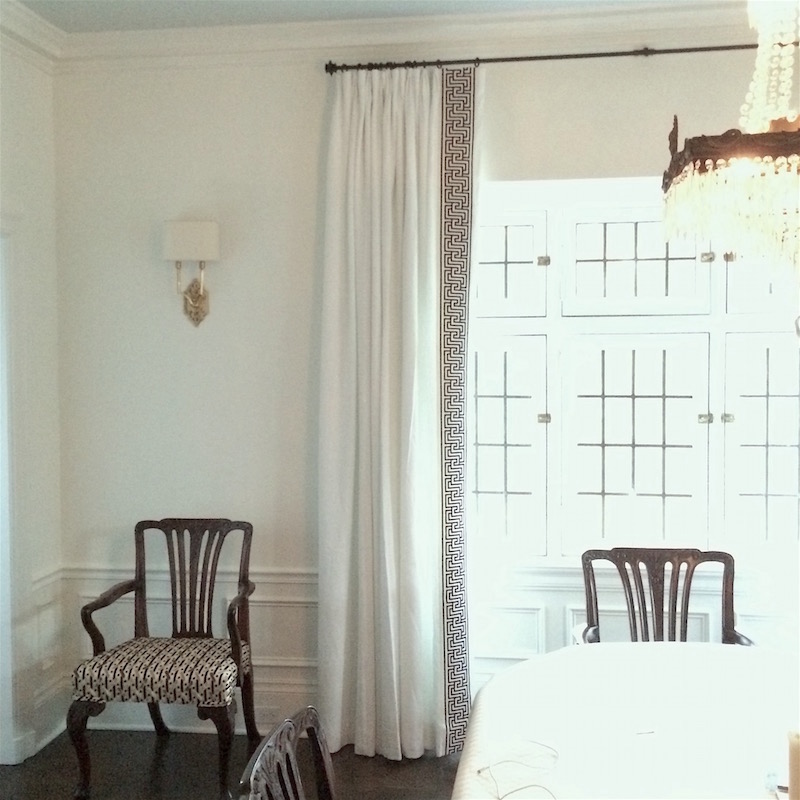
This is why it’s really helpful to understand how to calculate how much fabric you’ll be needing, yourself.
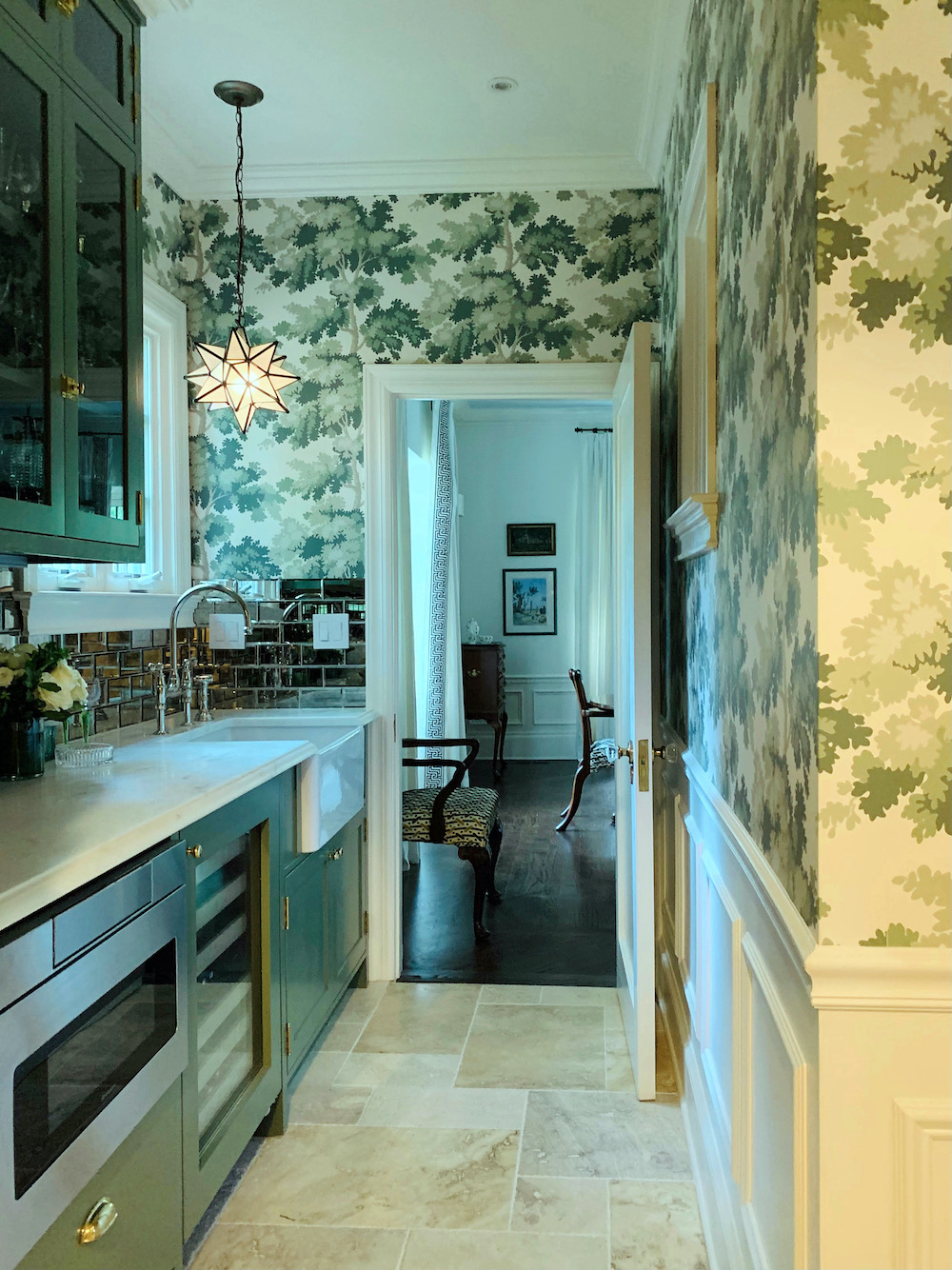
There are two directions to consider: top to bottom and side to side.
Let’s start with something simple.
In this case, we’re doing plain fabric for a 40″ wide window (including the casings), with an eight-foot (96″) ceiling height.
There are two directions you need to be concerned about: top to bottom and side to side.
Always measure the ceiling height and never assume any measurements.
Now, let’s say there is crown moulding taking up about 3″ of the wall. That means we have 93″ to work with. If we want the rod to go right under the moulding, we need to account for the rod sitting inside the bracket and then the distance down to the bottom of the ring.
From the top of the bracket to the top of the curtain is usually about two inches with my rods, but it might be different with yours if they’re thicker or your rings are larger.
That leaves 91″ to work with from the top of the drape to the floor.
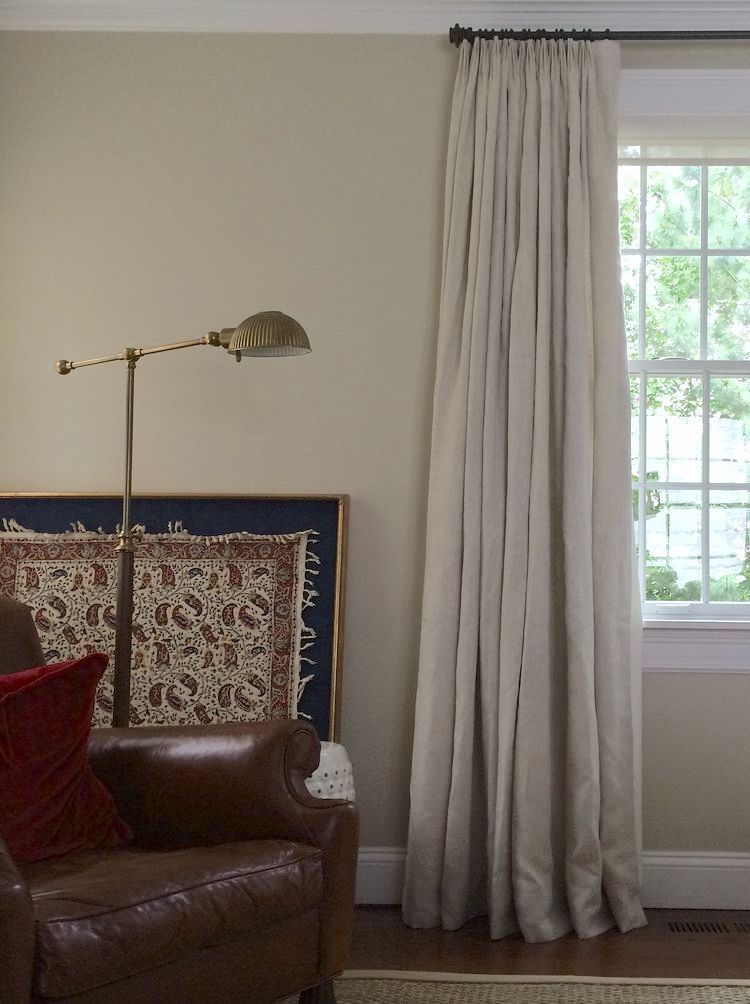
Most of my clients prefer the drapes not quite touching the floor. Therefore, your finished curtain will be about 90″-91″. I like a tiny break, or “kissing” the floor, as some call it. Not puddling. Kissing. In that case, a length of 91″-92″ will be terrific. Please remember that with hooks and rings, there is always at least a half-inch of wiggle room.
If you have a 9-foot ceiling, just add 12″. If the moulding is larger than 4″, then the length, of course, might be less.
Fabric is usually sold by the half-yard increment, so we need to round up to the nearest half yard to know how much we need for one panel width.
In addition to the finished length, we need to allow for the header hem and the bottom hem. For these, you’ll need at least an additional 12″, but to be on the safe side, let’s say, 18″. Therefore, for a 90″-92″ finished length, 108″ or 3 yards is what you’ll need to give your workroom for each panel.
Now, for the width. This information will help you decide how many panels you will need.
Most designer fabric is 54″ wide. However, our single panel without the return will be about 50″ before pleating. After pleating, it will be about 25″. However, the proper way to finish a curtain is to return it back to the wall. That is, if you can see the side of the window. If the rod is close to the wall, you won’t have to worry about a return of the fabric.
For measuring purposes, we’ll say that the return is four inches. Now we have 21″ left of our now pleated drape.
Let’s say our window width with casing mouldings is 48″. However, I like my rods to extend at least 3″ beyond the casing, and sometimes more. So, let’s say we have a 52″ rod. The curtain needs to cover this span in order to close, plus another two inches for overlap = 54″. Therefore, you will need each panel to be 31″ wide. (27″ + 4″ for the return for each panel) This is a panel and one-half.
However, if the drapes will be stationary, a single panel on a window this size is fine. Once the window goes over 84″ wide, I would do a double panel, even if the drapes are stationary.
But, let’s say that the fabric has a pattern with a 41″ repeat.
You know that you need 108″ of plain fabric.
108 divided by 41 = 2.63 repeats
But you cannot divide the repeat, so you will need to round up to three repeats.
3 x 41″ = 123″
123″ divided by 36″ (1 yard) = 3.44 yards per panel, or 3.5 yards of fabric required for a fabric with a 41″ repeat.
I generally add an extra yard in case there’s something wonky going on at the edges or the repeat starts in a funny spot at the top of the bolt.
Sometimes the fabric has a half-drop repeat.
Below is Chiang Mai Dragon, an iconic fabric by Schumacher with a large 46″ HALF-DROP repeat.
This means that 50% of the repeat is below the repeat on the left. Therefore, you will need an extra half of a repeat, which is 23″. So, basically, it’s an extra yard for a total of 8 yards to do one double-width panel. Or, to do matching left-right single panels.
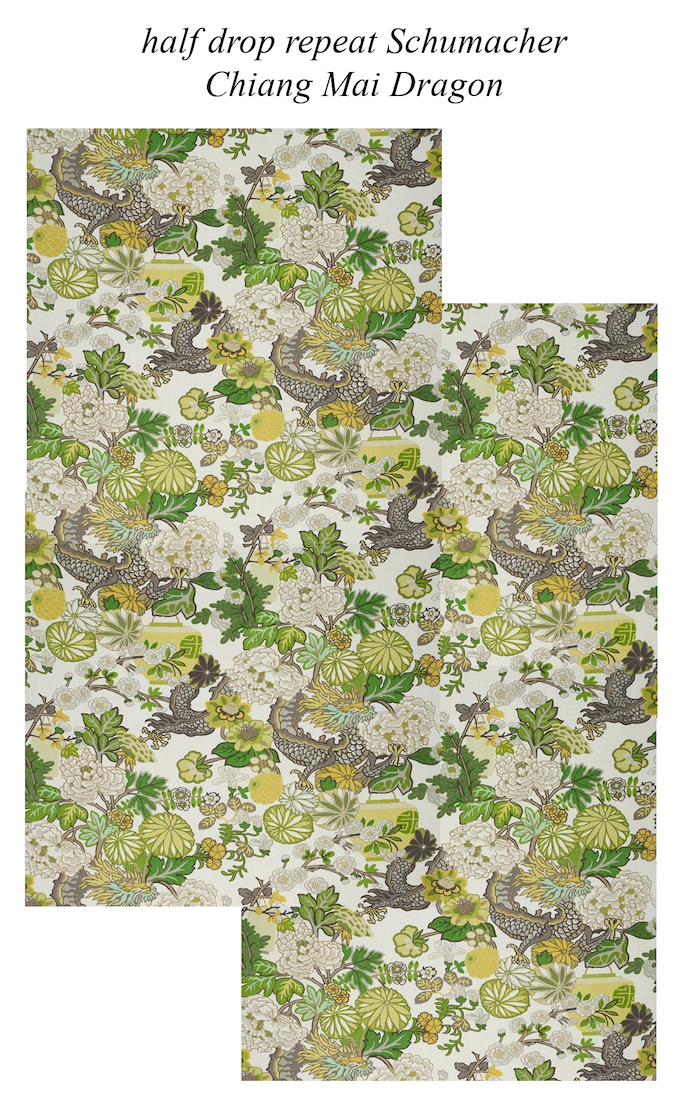
Again, this is for a standard 90″ length, which is roughly the length most of us are doing for a window in a room with an eight-foot ceiling height.
Why aren’t ready-mades made in this height, Laurel?
That’s a great question. This is the reason.
They are assuming that someone who doesn’t realize that a drill needs to be plugged in to work is hanging the drapes. Therefore, they are making it as foolproof as possible. And the way to do that is to hang the drapes at the top of the window casing. In other words, the screw will be going into some nice hardwood. (That is, unless it’s my house, where most of my casings are made from plastic. haha)
HEADERS
Because this is tied into the hardware, I am going to save this section for the hardware post.
LINING
Almost all drapes, unless they are sheers, need to be lined. Even with heavy fabrics such as velvet, the sun could alter the color in a bad way.
Here’s one of my best tricks to save money on lining, and it applies to all fabrics except for silk.
Most designer drapes are both lined and interlined to give them more body and a luxurious look. The interlining is usually a thin felt. There is an even heavier interlining called bump interlining.
However, there is also a lining material called thermal suede.
It’s a heavy-suede-like lining, which I have found negates the necessity for an interlining. This is going to save a lot of money! In addition, it provides thermal qualities, so if your room is drafty, this is going to help with that problem.
Thermal suede is still a translucent lining material, but it does block more of the light than does regular lining.
Be very careful with lining color. If it’s cream, it is going to tint your fabric with a yellow color when the light comes through! The same goes for the primary fabric. Please be very careful with cream-colored fabrics. They can go very yellow and/or dingy quickly.
SILK
Never use silk in a south-facing room. It will rot. Silk fabrics must be lined and interlined.
BLACKOUT
I rarely do this, but one workroom I used to work with would actually use a layer of black fabric between two pieces of regular lining. The reason for this is that it was softer than regular blackout fabric, which can be rather stiff.
SHEERS
I don’t do sheers a lot, but when I do, they are almost always linen. It’s such a lovely look. No shiny polyester, please. Semi-sheer drapes also come in cotton and wool. But wool will rot in the sun.
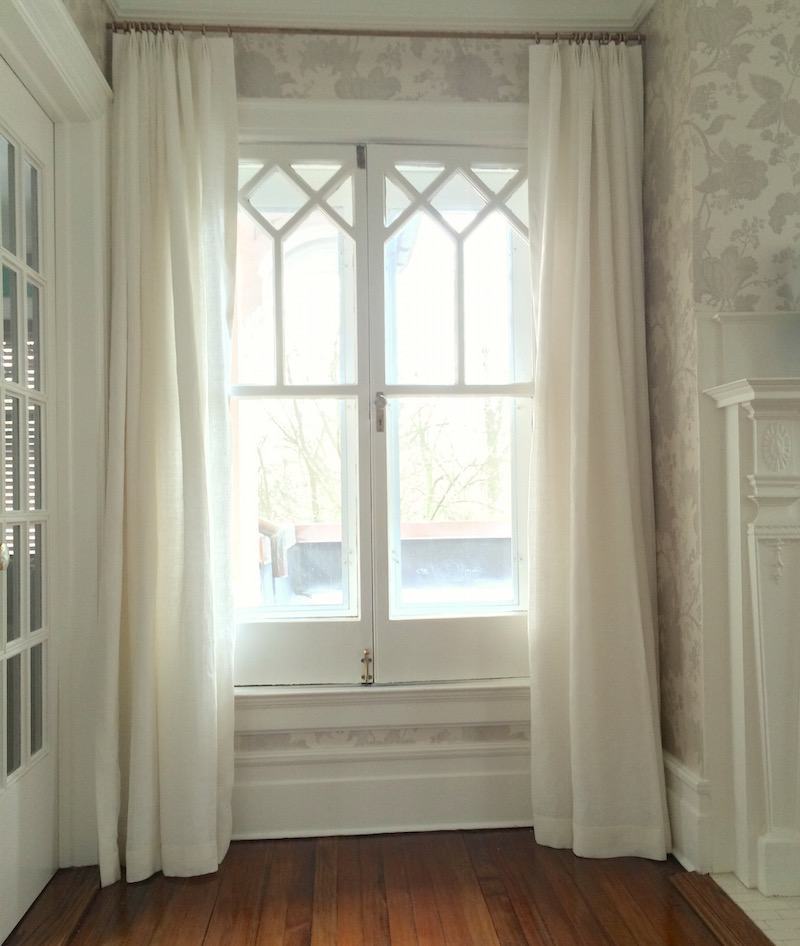
You can also line a linen sheer. It’s one of my favorite window treatment ideas, which I discovered from Victoria Hagan about 18 years ago. Below, you can see it in this romantic bedroom we did. In this case, the rod needed to fit between the two walls, so there was no room for a finial. I had them cut so that there is only a tiny gap.
You might enjoy these earlier posts about window treatments.
Freshening Your Home for the New Year {part IV – window treatment ideas}
A home for elegant entertaining yet durable for a family of six
Below is an extensive post, newly updated with a ton of new content, concerning drapery hardware. What to use, and especially what not to use!
The Best Curtain and Drapery Hardware – Everything you Need to Know! (Parts 1 & 2)
All of this information is good to know, even if you’re letting someone else figure it out.
Custom window treatments can be very expensive, and knowing exactly how much fabric is needed can help avoid ordering much more cut fabric than you need and is never returnable. Of course, you should always expect to have a yard or two left over.
I realize that this was a highly technical post. If this is new information, it might not be easy to absorb all of it in a single read. However, you can use this post as a reference. It does get easier over time. When I began my business in 1996, I let the workroom handle all of the particulars. But then, over time, I caught on and was able to figure out yardage on my own.
xo,

***Please check out the recently updated HOT SALES
Also, if you’re doing some shopping on Amazon, please click this Amazon affiliate link or the graphic below.

Thank you so much!
I very much appreciate your help and support!
Related Posts
 Easy (and affordable) Ways To Fix A Boring Room
 What are the Best Interior Color Schemes?
 My Gorgeous Antique Windows Have Turned Into a Nightmare!
 The Best Bathroom Vanities with Storage + Mirrors & Lighting (parts 1 & 2-1/2) + Birthday!
 I think I Just Made a Terrible (and costly) Decorating Mistake
 Brent Hull Says, “No 36-Inch Wainscoting!” Is He Right?
 100 of My Favorite Timeless & Classic Home Furnishings!








88 Responses
Your blog is fun to read and super helpful. Been following now for several years. I have used your advice from past postings on window treatments. Thank you so much.
As a basic home sewer I have ventured into more casual treatments and also Roman shades (RS). If you’re on a budget and want to try it yourself….this is what I’ve found…
1. As well as your post about them, there are great resources on RS at the “A square pillow isn’t square” YouTube channel and Sailrite.com.
2. Making RS isn’t difficult IF you measure very carefully and then triple check the measurements as you go.
3. I only used my sewing machine for the RS when attaching the Velcro at the top and the dowel channels. These days there are outstanding fabric adhesive products for other parts of the shade. Refer to resources I mentioned above on this. Steam a Seam is a particular fave of mine.
4. I prefer working with Linen. (I think they hang beautifully and for me it’s much easier to get the results I want with natural fibres). In one room I have Linen sheers with an unlined linen RS inside mount on window. In another I have linen sheers with a ‘hidden when not in use roller blind for light control’ in a bedroom. I don’t have wrinkle issues. (However as a home sewer I am fastidious about fabrics being ‘on grain’ so I don’t know if that contributes…in garment sewing it’s very important due to gravity effect on the weave)
5. IKEA is a fantastic resource for fabric. They have 100% Linen, 100% Cotton, and a 50 Linen 50 Cotton one that comes in wide panels that you can use as is or just use the fabric for your own creations. The prices are excellent.
6. If you’re doing a RS with a length less than 50ish inches you can ‘railroad’ the regular panel size.
7. If you want to do proper pleats (instead of IKEA supplied header method) with a bit of googling you can find resources to teach you how to calculate and make them.
In another application, a previous window treatment blog posting you did advising that matchstick bamboo are timeless, gave me the courage to order 8 of them for our A frame windows. It’s a rural setting with the vaulted pine ceiling. They look wonderful and are functionally effective for light filtering on the upper windows in summer. (Also, It’s simple to attach a lining on the back of these if you need privacy at night)
Thanks again for all the great information you provide. It’s very much appreciated.
I understand the rule for fullness, but so many ready-made drapes are only 50 Inches wide. In a large window, do you use two per side and just let them hang together? Or try to pin or Velcro them together?
Another question, do you have an opinion on patterned fabric for drapes? Seems like most of the photos are for solid fabrics. Thanks!
Oh, Laurel, how I laughed. I am 98 years old, so I have kept this memory about 80 years. I had just met my husband to be, we weren’t yet serious, however, I was at his house to meet his mother for the first time. Always awkward! Not knowing what to talk about, I said “I love this living room and the drapes are perfect.” You would have thought I had eaten my peas with a knife!! “these are draperies” not drapes!” It was a lovely evening!
Great post Laurel but I thought you’d want to know one of your paragraphs is duplicated.
Hi Alice,
Thanks so much. I had to go through the post three times to find it. I think it got messed up when I added some photos.
I have this thing about drapery rod bracket not showing the screw. Pottery Barn is the only place I’ve seen them. Have any other suggestions?
Hi Laurel!!
Let me start by saying that I’m so happy I found your blog!! My husband and I have been in our first home for 2 years now and I stumbled upon your site looking for the perfect shade of white paint. Now I don’t make a decorating decision without consulting your blog for your sage wisdom! Thank you so much!
I am getting around to picking out custom curtains and I fell in love with this %100 linen fabric from Kravet that’s the perfect shade of Aqua. The designer at the store is strongly recommending that I steer clear of 100% linen because it wrinkles and stays wrinkled. I was wondering what you thought about using 100% linen fabric for both Roman blinds and curtains and if you’ve found that it wrinkles terribly?? Any insight you have is much appreciated!
Many many thanks!!
Lauren
Hi Lauren,
I find that a heavier weight linen wrinkles less, but yes, she is right. As a rule linen wrinkles and crinkles and does all sorts of undesirable things. In fact for upholstery, I ALWAYS have linens knit backed. I’ve written about that here, if you look up knit backing in the search box it should pop up.
For drapes, I usually do a linen with a mix of cotton even poly on occasion. You’ll get the look without the wrinkle. Now, sometimes, a little wrinkle is okay. If in doubt, get a yard and hang it and see what it does. Do know that the drapes will be lined and that does help a little.
Oh, the other thing is that linen is not stable and the drapes can yo yo up and down. That’s another reason why I advise getting a linen blend.
Great question!
Seriously, where have you been all my life?
THANK YOU for this wonderful guide, which I found by accident here while looking for your post about moulding/molding. (That happens almost every time I visit: I start somewhere, and get so interested in everything else I forget why I came!)
I’ve always made my own window treatments…and am about to tackle new draperies…so this is timely and helpful.
C-rings!!! GENIUS!!
Locked away in a closet, Em. But I’m out now! Hooray!
Hi! I want to put fabric trim/band on 2 curtain panels. Typically, I see pictures of bands running down panels on the leader side. Is there any reason I shouldn’t run it across the top? I plan to have parisian pleats. I don’t want to run the band on the bottom as the curtains are mostly behind a sofa and end table. Thanks for your advise!
Hi Kim,
I would not run the border under the header. It’s fine to just do it down the fronts. That’s what I typically do in any case.
I’m almost afraid to ask, but does anyone do shutters anymore? I just find them to be so clean, practical, easy to dust and filter out damaging light without darkening a room. Laurel I know if I ask, you’ll give your honest opinion…lol!
Hi Joan,
A few times I’ve had a client that wanted them and when they find out the price, they go… nope. Let’s do wood blinds instead.
They aren’t as popular in the northeast as they are in other parts of the country.
I like the old kind in an old home and I like the old paneled storm shutters that lay flat against the deep frame, but that’s a different animal.
Hi Laurel,
Did I miss your post on shades and blinds? Because I need to know if wooden blinds ( or faux wood) must match the hardwood floor stain color.
We are slowly (budget 🙁 ) restoring our 1926 Tudor cottage, but need to stop flashing the neighbors!
Old school venetians are a little too authentic for my husband, he likes matchstick style. They just look wrong to me because they are lighter than the walnut floors.
What are the rules about this? Mother says never to have more than 2 wood tones in a room (painted wood doesn’t count).
You may not know it, but you’ve been guiding us every step of the way! I practically hold my breath until your Sunday posts.
We are so very grateful for you, and wish we could bring you down to Philadelphia.
Babbette
Hi Barbara,
No, I never did a post about this. Hang on! Soon!
Ok I didn’t see this asked/answered – is the 4″-6″ for the rod from the window itself or the window trim? thank you!
Hi Cathlin,
It’s from the outside edge of the trim. But only if space allows. And for large windows, I usually only extend about 2″
Thank you!
(And for my record of insanity, all I know for certain is Roman shades for the bathrooms and I’m absolutely stuck everywhere else 😱😂)
An update! (I’m sure you were staying up nights hoping for one ;))
This post and the one Roman Shades Weren’t Built in a Day helped me not just figure out a good starting place but to find a good workroom. I was able to talk to some of the esteemed professionals and when I met with one she gave me good “laurel vibes” – what she said matched with your advice. 😄
Oh Cathlin,
You warm my heart with your lovely comments! And I’m glad you found a good workroom!
Hi Laurel!
Great job as always! I have my own custom window treatment company (we design and make all types of window treatments). I always hold my breath when someone does a window treatment post, because as you said, they don’t teach it in design school. So, sadly, there is a lot of misinformation out there. But you did a wonderful job with this post!! Very informative on both construction and design!! I will say we differ in opinions on small rods vs. larger rods though. Small rods take so many more support brackets (especially on larger windows), so I tend to like larger rods. I, personally, like the chunky look of them too.
Hi Gretchen,
Thank you so much and I’m glad that you approve. It’s fine about the rods. I think I started liking the thin rods a while back when I saw them in a magazine article. But for large windows, they need to be a little thicker.
so informative! thank you! we have 3 large windows- each requires a 12 foot rod. do you ever use traverse rods to ease opening and closing? we’d need the double traverse to incorporate sheers… just wondering since you don’t mention traverse or track systems. thanks!
Hi Falu,
Generally, I only do a traverse rod if there’s a valance. However, there is such a thing as a traverse rod that looks like a decorative rod with rings. Otherwise, the drapes do close easily by pulling them across the rod. When using sheers, we use a double rod.
I was so happy to see and read your article on window treatments as our new build is nearly finished and needing help in that area. When I linked to your related articles my heart stopped when I came across one of your ‘don’ts’ regarding transom windows. You say never hang the rod below the transom…and now we’re not sure how to proceed as we have one of those ‘view window walls’ in our Great Room. These view window wall configurations present a unique challenge we’re wondering if you can address. In our situation we have a set of French doors (going out to the patio) and a matching side panel window on each side, leaving about 3′ of wall width on either side. A rectangular transom is just above these four window/door panels and above that is another transom but that one is arched. This French door and window configuration reaches high into a vaulted ceiling which doesn’t leave enough room width wise to hang a rod above our arched top transom. We thought maybe we’d hang the rod either on the window trim just above the 6’8″ French doors and window side panels, or else on the window trim between the first rectangular and second arched transom which would leave the top arched transom uncovered which we don’t mind. You advise against this but we have no idea how else to apply a window treatment in this situation. We’d prefer avoiding Roman shades and other applications that would reduce the view and window space since the’ll be mostly open anyway…These kinds of window configurations seem commonly designed for ‘view’ Windows so others must experience this problem too! We’d love to go without draperies as we love all the natural light pouring in but also feel we should have some occasional protection from the sun on our hardwood floors and the option of some privacy at night although we’re not closely situated to our neighbor’s. We’d like something lightweight that can be moved away from the doors and windows most of the time
but allow for some sun and privacy protection when needed. Can you advise us and others with window walls some ideas of what could stylishly accomplish this? If there’s a way to send a photo example please let me know! I love your blog and your great sense of humor which often makes me laugh out loud, so fun! Thanks for any advice.
Another great post. So much information. Having made draperies in the past I know there is an art to the profession.
I like your rod recommendations. When in need of them for my next project I will keep them in mind.
Thanks for stopping by Rebecca. Much appreciated!
Hi Laurel, thank you for this very informative post. I am going to make drapes for our master bedroom, have already bought the fabric but wasn’t sure what the difference between blackout and termal lining is. Now I know 🙂
Would you please, tell us some more about weighting the drapes. Do you weight the inside corner only, or both corners, or the whole bottom edge? There are individual weights, which can be placed at the right positions, but there is also a chain-like weight, which I suppose goes all the way through. Would appreciate your advice about this.
Hi Val,
I’m not 100% sure about this but I think the thin chain weight is for sheers. My workrooms always weight only the corners. There are special weights made for that purpose. They should be covered in fabric if they don’t already come that way.
Hi Laurel,
Question – In all the magazine photos I see of average sized windows, there is only one center bracket, and the end brackets. My workroom recommended two additional bypass brackets-one each right at the edge of the window, and then the end brackets that extended out my desired length. She said they recommend that because the bypass brackets put next to the window for sure go into a stud, whereas brackets that are some distance off the window would likely go into drywall, and especially with iron rods could come out of the wall. So I figured better safe than sorry so there are now three brackets in between end brackets for a total of 5. I wish it were a cleaner look. Any input on that? Thanks!
Hi Monika,
Well, first of all, there is no “for sure” when putting up rods. I swear some of the new homes don’t have any studs!
I don’t want to tell your installers how to install, just my experience.
We have put up many a rod with no studs available. There is special type of screw, with different names. A butterfly or mushroom. But it expands when it goes in and provides a far stronger attachment if only going through sheetrock. The disadvantage there is that they make a big hole and if they goof it can create a problem.
This is one reason this is so difficult. It’s not the installer or the rods. It’s the house!
We have never had to add two extra brackets unless the window is exceptionally long.
But, even if your installer insists on adding the extra brackets, the fabric covers up 95% of it. You’ll hardly notice it. At least you wouldn’t with the rods/rings I use. Notice in the photos that you don’t really see the end brackets. If you use a larger ring, you would notice it more.
You are amazing and crack me up at the same time. Your sharing is such a gift! Education for the decorating dufus in me.
Thank you again Laurel!
My pleasure Sheryl! I’m enjoying myself too! And also learning! You know the old axiom. “When one teaches, two learn.”
OK, so this is what you do if you are a broke, unemployed reading teacher. My “drapes” in my living room are Jacobean floral shower curtains I bought at Target. Hey, whatever works!!
Haha! Love that Susie! I love Tarzhay! My sheets and towels are from there.
Laurel, This is a wonderful post. We recently moved back into our home in Atlanta after renting it for 5 years. We have been working on lots of repainting and new flooring, etc….We have a Palladian window which is in the front of the house in the master bedroom and I was going to use the Pottery Barn black out drapes that I had in my last home and had them re-hemmed. They are silk and cream color. Now, I’m not sure. I definitely need something to keep the afternoon sun out and would like something that affords a dark room for sleeping. What do you typically do with a Palladian window? Thank you!
Hi Pam,
There are pleated shades that will fit in the curve and it is possible, i think to do a curved Roman shade too. Yes, I just found an image and pinned to pinterest. https://www.pinterest.com/pin/256142297535204182/
Yours is probably just one window, but it seems that it could be adapted. It’s a bit of engineering since the workroom with need to mount the shade on a curved piece of wood to match your window.
The other possibility if you have room is to hang your drapes above the arch of the window. Of course, you would probably need to add a piece (at least 16″ or to follow a natural level like the bottom of the sill if it’s fairly low) to the bottom of the drapes. I do this all the time as a matter of design.
I’ve either done the latter or done Roman shades in the lower part of the window only. You can see that in this post.
https://laurelberninteriors.com/lets-add-home-builders-firing-line/
Thank you so much…this is very helpful!
Dear Laurel – I’ve read your blog for ages, and used so much of your advice …. and now am hoping to ask for a little more. I am in the process of ordering window treatments for our home and had picked out linen to use for some custom flat roman shades in several rooms.
My sister, who has a background in the arts and has wonderful taste, said that linen would be inappropriate as we live in Chicago and it’s inappropriate for Northern temperatures. But I feel that I see it used in Northern states quite a bit. I’ve made up my mind to use it, but she is always so sure in her opinions that I know I will always wonder if it will look odd. From this post, it doesn’t seem that you agree with her (as you discuss using linen for curtains) but I would really welcome your thoughts on this.
Thank you so much in advance!
Hi Elizabeth,
I’m not sure what she means by northern temperatures. You’re indoors, right? It’s for the drapes not a suit you’re wearing.
Most of my drapes and those of my northern colleagues are either linen or cotton or a blend.
BTW, I was born in Chicago and loved going to visit my grandparents after we moved when I was a baby.
That was a great tutorial. I owned an iron shop for 18 years and used to have my shop make all my drapery rods with solid round bar and finials. I agree adjustable rods are flimsy and should be avoided.
My favorite window treatment is roman shades. Would love a tutorial on that style.
Thanks Laurel!
Hi Diane,
We only did the adjustables once– maybe 18 years ago. It took 4 hours to hang two windows. Unbearably awful.
Roman shades will be coming soon. They are my fave treatment too. I’ve done 100’s of them!
Great post. I make all my draperies and curtains because of the expense. I also taught our daughter to make hers or I make them for her. I do pleated, lined drapes on rings using buckram but never bump as its unneeded in our climate. The absolute worst part is measuring! ,out rooms the drapes need to close so this quote “If the drapes need to close, I calculate that there will need to be a full panel for every 24.” is wonderful for me! Thank you. I’ve never done the Parisian pleat but will be starting new drapes for a sliding door this week so I’m intrigued. Regular pleats with a folded header and buckram are a pain and my old arthritic hands take a hit. I do have a heavy industrial machine though. Parisian look softer and perhaps easier. MANY great tips here. Thank you.
Hi Pamela,
I have great admiration for those that sew. I used to a little in my youth–but quite badly. lol In typical fashion, my ideas were the fun part, not the execution of them. The Parisian pleat is beautiful. If you look in the main shelter magazines, it’s the one you see most often these days.
Laurel,
Thank you for sharing your knowledge and experience. Very generous of you.
A question…What about stacking the open drapes far enough to each side (if you have the wall space to do it) so that ALL the window glass is exposed? My house is dark and I need all the light I can get. Is this considered unattractive?
Thank you for your input.
Wow what a fabulous post. Thank you so much Laurel. I’m trying to figure out how to pin the whole post!
If you pin one of the graphics, the link is embedded in the image so that when you click on the image (in pinterest) it will bring you and hopefully a lot of other people back to the page.
Actually, you can pin any image and it will bring you back to the post!
This is why I love pinterest so much!
Excellent post, but it confirms why I prefer naked windows. So much easier. Window coverings overwhelm my tiny brain.
Hi Christine,
Indeed! Not your brain, but the window treatments! lol
Thank you, thank you, thank you, Laurel! I am getting close to the point of doing the drapes for my LR/DR project and this was perfect timing! Love your blog! Happy Easter and all the best to you and your family from Dayle in Winnipeg,Manitoba (still some snow on the ground here!)
Hi Dayle,
You’re very welcome! Glad it came in time. Sorry about the snow. Blessedly, we got a reprieve this year and the signs of spring are most evident; last couple of years, not at all until mid-April.
I had curtains custom made once in my life. I was young(I think now-very young)), and it was a huge expense for us. HUGE. They were the most beautiful organza sheers-little bit of an ombré effect, where colors are almost same but change ever so slightly like in a watercolor painting. They were tons of fabric as they were for a very wide french door opening to the big balcony-they took all the wall and had to drape nicely being sheers. They were professionally installed by the store that made them. They had rings of my choosing. They made a modest place into something else without being pretentious a bit.
Long story short-we had to move overseas and rent the place. I payed a cleaning lady to do a deep cleaning(which I didn’t do back then, being young and able), I payed the painter to refresh the whole house. And I left the curtains. I wanted our renters to feel at home..
When I came to see our condo in several years, it looked sad, broken, unkempt. My curtains were long gone, and the renters claimed they were probably taken by some previous renters..
It was traumatic to the point that I eventually decided to sell the condo. I couldn’t take a good care of it from afar-I would rather see it owned by somebody who loved it that being slowly ruined.
I realize it’s a totally unrelated story, lol. But the more of your soul you put into a thing-the less thing-y it becomes to you. With all the consequences of being less thing-y..
Great post, Laurel, as ever. Your posts never leave me indifferent, curtains or not..:)
Hi Jenny,
I totally do get that. Our homes are our havens and it’s very possible to become emotionally attached to things.
I’d be upset too, to come back and find my things missing or trashed!
Thank you, thank you! Perfectly detailed post, as always, and user-friendly advice! Is there a type of lining you can suggest for noise control? We live in a town home in the city with lots of drunk kids heeing and hawing outside our bedroom window when the bars close at 2:30 a.m. We tried to find the noisiest ceiling fan we could to help drown out the noise, but that’s not enough!
Hi Joanne,
Yes. A shotgun! lol Geeezzz. I feel for you. But I would suggest using two fans. I have to sleep with one on. In fact, I often just run it during the day too. Even though it’s quiet where I live, it’s just another layer of white noise.
But, in answer to your question. There is such a thing as an acoustical curtain. Here’s a link for one. https://www.moondreamwebstore.com/soundproof-curtains/beige-soundproof-curtain-eggshell-175.html?gclid=CIj18v2u4ssCFcRehgodyx0HAA#/fabrics-cotton_effect/sizes-57w_x_95l_145cmw_x_241cml/finishes-grommet/shade-beige/mc_color-beige_mc_634
I’ve also seen some that look like mover’s blankets. It could be a cool look. I would match the wall color to the curtain.
Laurel – you are psychic! This is about the 10th time you did a post that was exactly what I was working on… Currently contemplating the drapes in my dining room and you have given me tons of great thoughts. I did buy the Rolodex so am going to pursue the black rods and rings that you specified. I think you have also saved me from going too yellow on the fabric (with cream), and convinced me to go for the Parisian pleats. Thanks!
Hi Kim,
Well, I’m glad we’re on the same wave-length. And yes on the cream fabric and reminding the workroom not to use cream lining. It’ll just compound the yellow. Sometimes it’s okay but usually it’s not.
Laurel, this was so refreshing to hear all this important information. I have been a decorator for over 15 years and it is so important to know all of this. I currantly work for a small store that also is workroom ( Weschester, NY) and you would not believe how many decorators come in and have No clue what they are doing. Yes I’m there to guide them but not to do there job.
I pride myself on the work I do for my clients and I can see you do too.
Love your blog
Wendy
Hi Wendy,
Oh I would believe how many come in and not know anything. Even IF they were trained. Because as I think I said in the post, they do not teach ANY of this in INTERIOR DESIGN SCHOOL. In fact, 90% of what I know, (and need to know) I learned after the 3 years of design school. I did learn a lot of things, however, I’ve never had any use for whatsoever. Oh well…
And then my first job, working for someone else for a few years had her workroom do everything. I did learn some things there. And then, when I started my business in 1996, in the beginning few years, I muddled through, but then, after a while, caught on to the terminology and details. I always knew what I wanted, however.
Hi Laurel
Beautiful curtains just make a room, don’t they?If I had pots of money, I’d surely have all my curtains done professionally, but for the most part, I almost always make my own curtains. Because I don’t do a complicated construction with handmade pleats and use pleater’s tape instead, the curtains turned out very well, but I wished I had your advice when I made my first pair many years ago, it would have saved me a lot of trouble.
I did have a problem with the last set I just sewed.I found a R Lauren Indigo& Cream checked,100% linen fabric with a total repeat of 4.5”.I lined the curtains, but for the first time, I didn’t use pleater tape and pleater hooks, I worried about matching all those checks, and I wanted a soft ‘natural pleat’- I justr used the round rings and pins..I notice that the checks appear to be slightly ‘sagging’ and so not lining up perfectly across when you look at them from the front. Not good. I think I’ll have to take them down and sew some buckram to the top to stabilize the ‘sag’ ..
Thank you for another great Sunday post!:-)
Hi Dolores,
I admire that you make your own curtains! I remember sewing a million years ago. I had a bunch of half-sewn dresses. I wasn’t very good at it.
I’ve seen those tutorials for “no-sew” drapes. I think for something simple and casual it could work. I think I’d rather just get ready-mades though and re-hem them.
Laurel, love your blog! So informative.
Thank you Roz. Much appreciated!
What are your feelings about treatments over sliding glass doors? We’ve got a mid-century apartment with sliders in every room.
I got draperies for the two bedrooms, and the track is mounted on the ceiling. Parisian pleats, black out lining (because they’re bedrooms), and they look nice. But we haven’t done the living/dining room yet. Not sure a rod would work because there’s such a small space between slider and the ceiling.
8 foot ceilings, sliders, mid-century. I feel like my “traditional” drapery options are limited.
All that said — destroying the vertical blinds that used to be there was revelatory.
Hi Tracy,
I think for your apartment keeping the window treatments very simple and light on a ceiling track is probably the way to go.
Laurel,
I just love getting your emails; they are so informative and beautiful at the same time – thank you!
One question (and I apologize if it’s been covered in your post, but I missed it):
I don’t understand how the curtain or drape looks when it makes the return when using a rod with a finial on the end. You mention it in when describing the Parisian Pleat drapes on the antique gold curtain rod but the photo doesn’t illustrate that detail and I’m having a very hard time visualizing it.
Thank you!
Anna
Hi Anna,
I looked and looked for a decent image of that and came up short, but this is a terrific post which demonstrates the drapery return perfectly. It’s just as I describe. A 3.5 piece of the drape turns back 90 degrees and gets clipped to the wall.
As an aside, I prefer rings with pins that you don’t see, not hung from clips, but the rest is terrific! https://www.addicted2decorating.com/how-to-hang-draperies-and-curtains-like-a-designer.html
Thanks so much Laurel – that’s excellent and just what I needed to see. You are so helpful!
Laurel – Thank you so much for this drapery guide!! I’m currently pondering a project in my master bedroom, so this is quite timely!
No matter what the topic, I always learn an abundance of info from reading your posts. And your sense of humor is refreshing and fun! Keep up your great work!
Thank you so much Vonda!
Thank you for your wonderful insights Laurel! Great job!
Can you kindly let us know the beautiful blue paint color on the ceiling in the “Mario photo”? And the walls?
Blessings!
Thank you for your wonderful insights Laurel! Great job!
Can you kindly let us know the beautiful blue paint color on the ceiling in the “Mario photo”? And the walls?
Blessings!
Thanks Lidia. The ceiling paint is Benjamin Moore Glass Slipper 1632. The walls are Cotton Balls OC-122
Thank you, dear Laurel.
Happy Easter to you and your loved ones! Peace. 🌺
Bravo, Laurel, on your summary of drapery requirements! I own a drapery, etc. workroom so have loads of experience with this topic. I wanted to add a few more points.
First, while 2.5x fullness (drapery fabric measures 2.5 times wider than the rod) is standard, often sheers, especially if they are not lined will be figured at 3x fullness. This is because the fabric is lighter weight so more is needed to look equally full or generous as a regular weight, lined fabric. Also it “stacks back” (pushes to each side off the window) to a smaller amount so more is needed not to look skimpy.
Second, pleating of any sort helps control the fullness in the fabric when you close the drapes. Without pleats, as for the flat header, if you pull the drape by the “leading (middle) edge”, only some of the fabric will move to cover the window and it will be perfectly flat, while the other 2/3 will be left bunched on the sides. You can rearrange or “dress” the drapes to spread out the fabric pulling more of the excess over bit by bit, but that takes time and practice have it look properly casual. With custom pleated drapes the fullness of the fabric is distributed equally across the width of the drape and when pulled closed the drape will fill the opening evenly leaving the same amount from bracket to center on each side (with a touch of ease added in). They also look neater when opened. So flat headers without pleats are most often used for panels that are “stationary” (not designed to be opened and closed) so can be dressed by the installer and theoretically not touched again. Or they are designed to be intentionally ultra-casual looking.
Lastly, for every rule in draperies there are exceptions. Knowledgeable designers and workrooms through experience understand when it is good or preferable to bend the rules.
Sorry if this is TMI…but I couldn’t resist adding a few more bits of info for those interested. I have a passion for drapes!!
Hi Frances,
I concur with all–especially the rule part. I think that applies to all areas of design. Lovely website you have too. I’ve never done sheers alone unless they are linen and lined. About 13 years ago, for a couple jobs used a wool semi-sheer which drapes gorgeously but after seeing what the sun does to wool in my own home. (thank God it was mine!) am reluctant to use it again.
Thanks for your input!
Hi Laurel,
I loved hearing you on the recent Podcast, your voice is so elegant!
This is a very useful post as usual. I am wondering if you remember the paint color you used in the room pictured in this post which you say you did 13 years ago. It features two white chairs, two floor lamps and the colors are whites and creams, the paint looks like a yellowey tan maybe or……? I would love to know, it is just what I am looking for now!
Thank you!
Ellie DeWitt
Hi Ellie,
Thank you so much. Now, for that paint color. I am not 100% positive, but I know that it was from color preview, because those were the years that they weren’t marketing the “classic colors.” I actually still have my fan deck from then and I’m pretty sure that the color is sulfur yellow 2151-40 which is not really yellow, but a classic gold.
Excellent! This is exactly what I have been needing. Can you tell how we locate an installer?
Hi Massey,
It’s not always easy. The people who make your drapes, the workroom, should know some installers.
This is wonderful! Thank you.
Gosh, what took you so long! lol
Haha I feel like such a creeper! I can’t help it, you seem to push posts live just after I’ve put the littles to bed and am like, “Ooh, me and The Internet time!” 😄 Plus, I’ve been a ball of stress for weeks about window treatments.
Not at all Cathlin. I’m stressed out before every window treatment installation! And let’s see… how many have I done by now? A couple hundred at least. Most of them go alright, but every once in a while, there’s an issue.
I’ll never forgot the time, the workroom,(not one I’m currently using) I don’t know what they did, but there were dozens of little threads between the lining and the fabric on white cotton Roman shades. Six of them. When the shade was down and the light came through, it was very noticeable. I freaked. Thank God the client wasn’t home! The installer and I spent two more hours, “shaking” them down to the bottom (very difficult) so you couldn’t see them.
Ahhhh!! That’s the sort of thing that would keep my husband up all night 😄 Fix the threads!
I dearly hope to just get in what we neeeeeed and then get design help. …but in the meantime, ay. Blinds, shades, drapes – blinds and drapes, bare window, shades for privacy that allow light. Yeah, my brain is a mess right now. 😄
Yeah.. shades and blinds will have to be a different post.
Oh, yeah, I got that – this is just the depth of my window treatment related woe 😇