


There is an addendum to this post to clarify several things. So, we’ll call it part 2. If you wish to skip to that part, you can click the link below.
Part 2 Begins Here
Hi Everyone,
I was all set to continue with the renovation shopping list (here it is, if you missed part 1), but just now, I happened to see this on my Instagram.
It’s an announcement that a vote will be taking place regarding the New White House Ballroom extension.
Many of you will recall that last October, I wrote two blog posts concerning the sudden demolition and the proposed new structure. (They will be linked to shortly.)
Soooo, if any of you would like to submit your own comment to the National Capital Planning Commission (NCPC), you have until
March 4th NOON ET – get it in. Sorry for the short notice; however, at least I found out before it’s too late.
Below is my Comment to the commission.
If this is important to you, I’ll be including the links to where you can send in your own comments. If you’d like to use my statement as a base, please feel free to do so.
***
Dear Members of the NCPC,
I am a classical interior designer based in Boston, Massachusetts, with more than thirty years of experience working with historically informed classical architecture and interiors. To begin, I would also like to thank the Commission for the careful attention you are giving to this important matter concerning the White House. As you know, it is one of the most historically significant examples of classical architecture in the United States.
I was deeply concerned by the demolition of the existing East Wing without meaningful oversight, and even more troubled by the currently proposed design for the new ballroom addition. It appears to be dramatically out of scale with the existing architecture and the historic character of the White House.
Last October, I wrote two detailed articles for my interior design blog examining the proposal and the broader historical context of the White House.
These posts include historical research as well as my own conceptual alternative that respects the classical principles on which the building was founded:
The White House Ballroom– Good Idea or a Colossal Mistake? (blog post #1)
The Irreplaceable Loss of JKO garden and EW of the White House (blog post #2)
In my research, I also revisited Caroline Harrison’s late 19th-century proposals for improving the White House grounds.
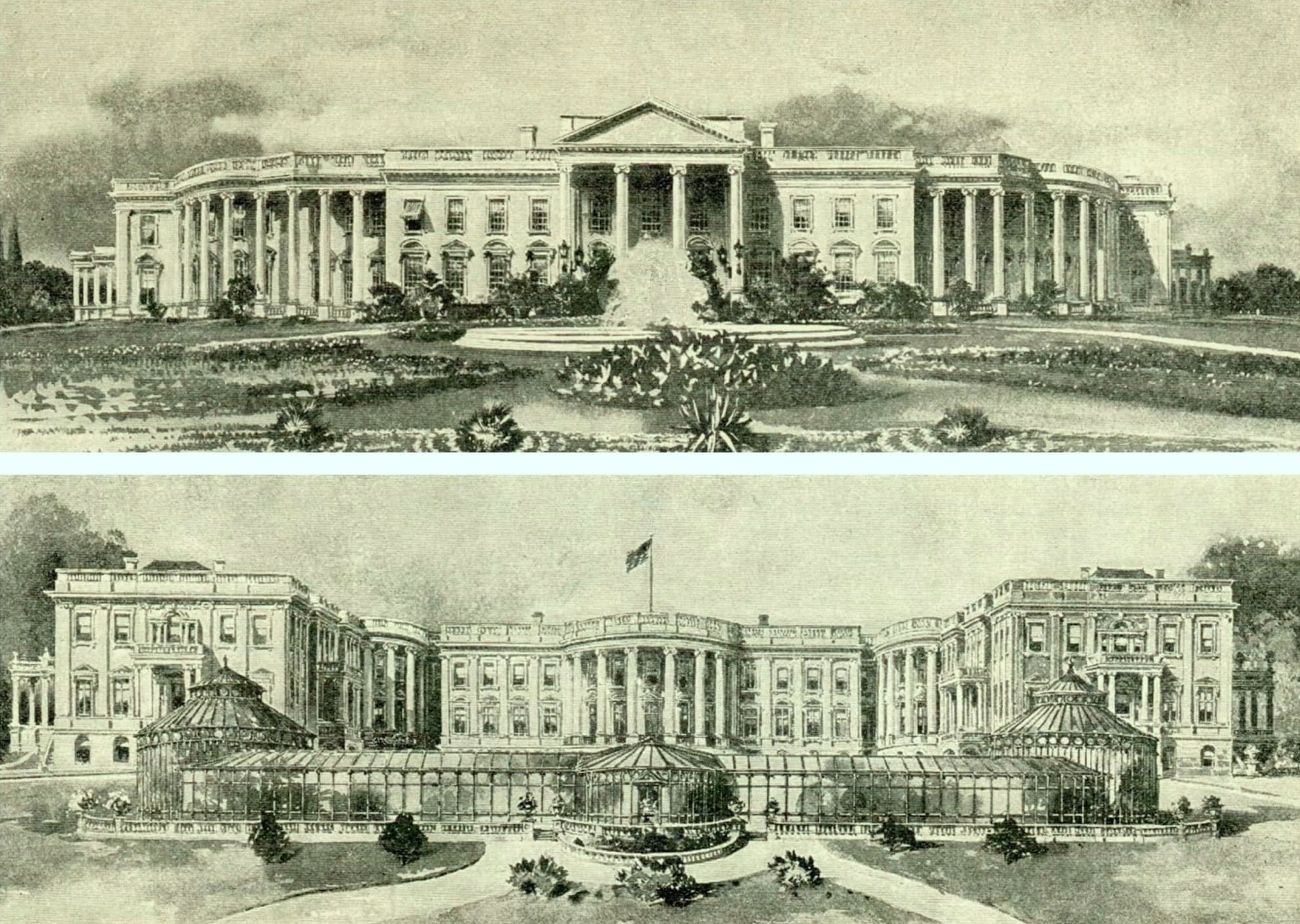
Below is the plan view for the bottom elevation, above.
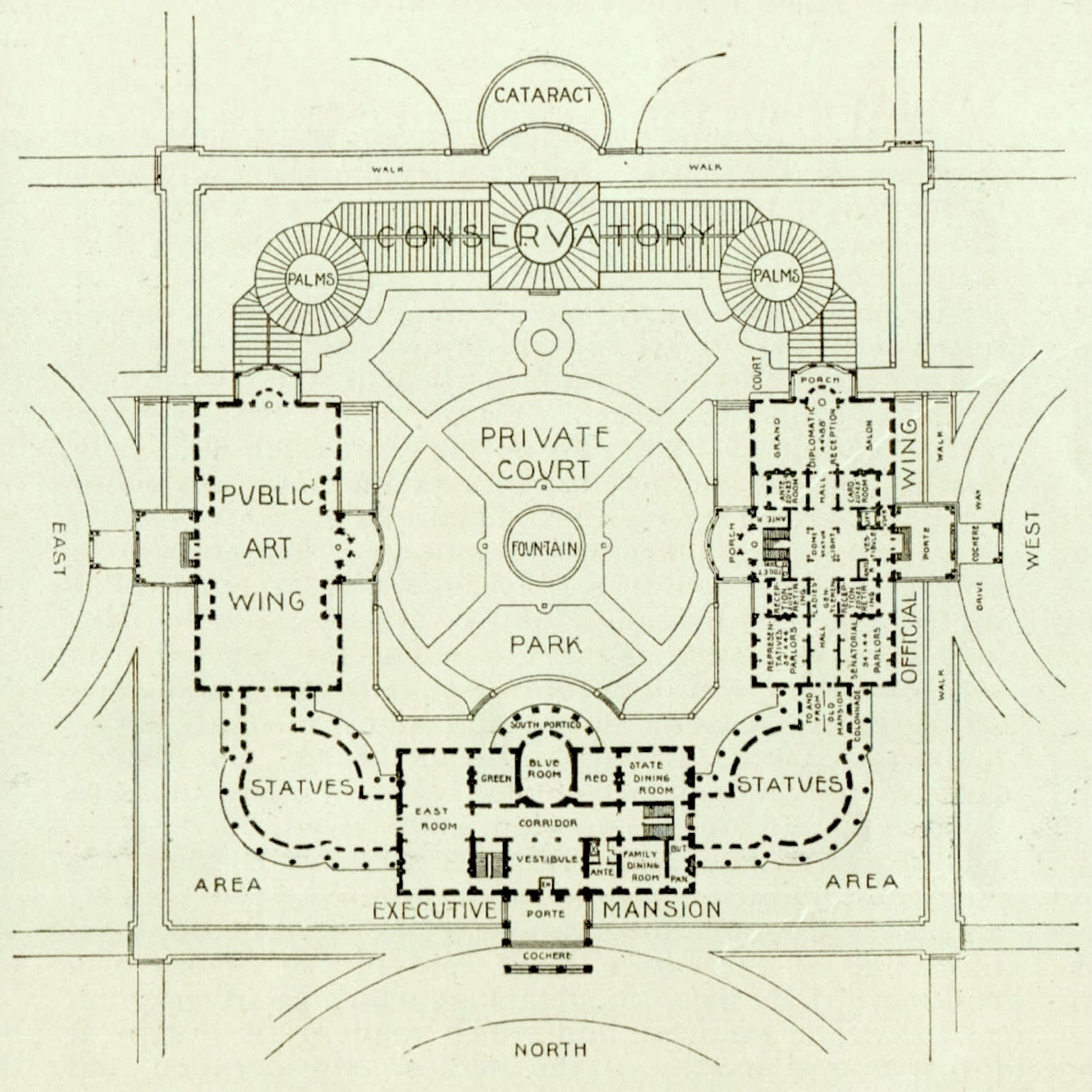
While her ideas were ambitious, they point toward a more thoughtful approach to expansion than the oversized ballroom currently under consideration.
It is my understanding that the West Wing is also insufficient for modern needs. In response, I developed a schematic plan (attached as a PDF and shown in the first article) proposing two balanced auxiliary wings. Each would maintain a footprint no larger than the White House itself and would be architecturally complementary to the original structure.
In response, I developed a schematic plan (attached as a PDF and shown in the first blog post) proposing two balanced auxiliary wings.
Each would maintain a footprint no larger than the White House itself and would be architecturally complementary to the original structure. I hope the Commission will take a moment to review the attached plan, as it illustrates how additional capacity could be achieved while preserving the historic proportions of the White House complex.
This approach preserves the essential axial relationships of the site, including the important sightlines toward the Capitol.
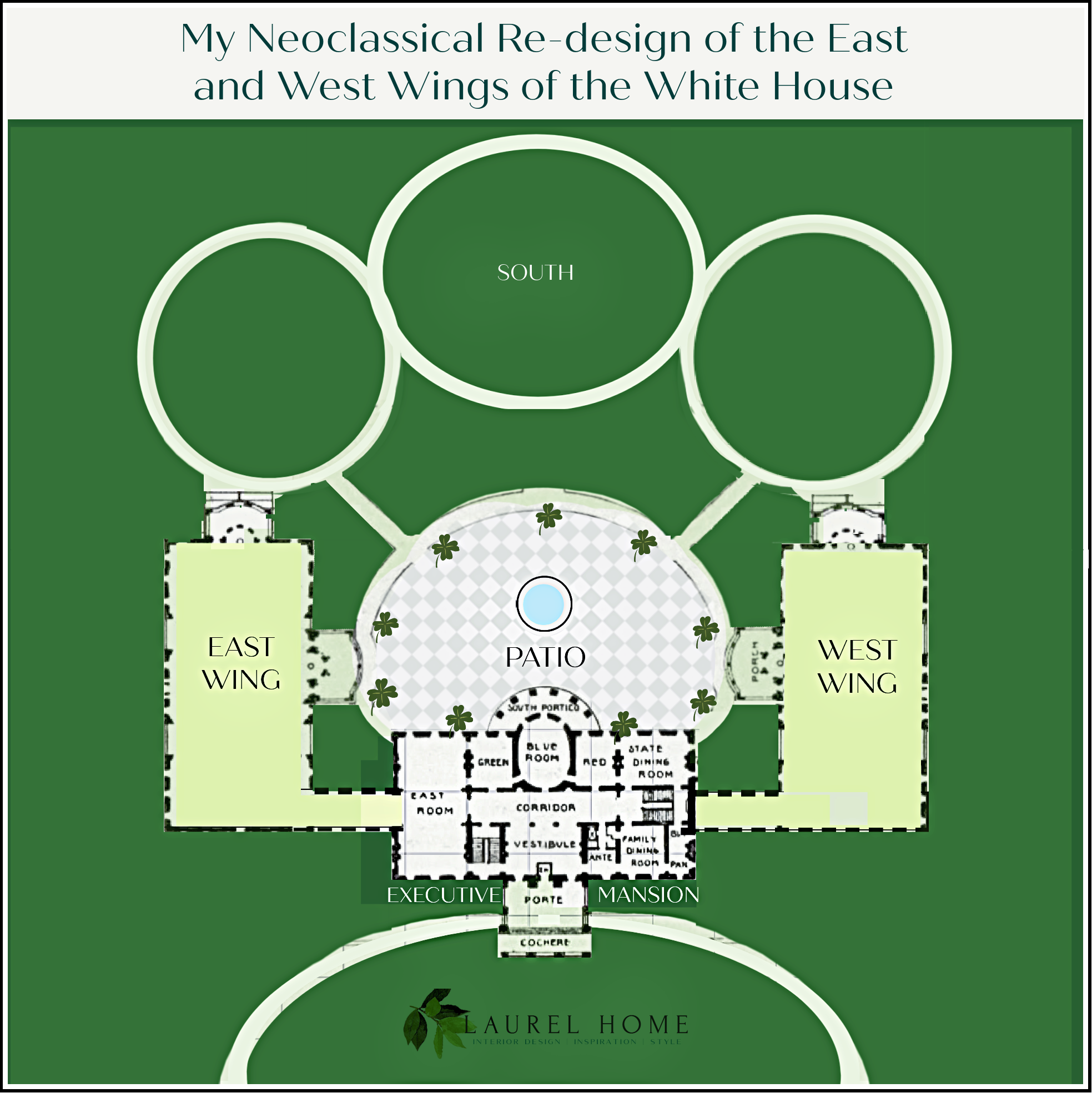
The three circular forms shown on the South Lawn are symbolic of the three branches of government while also referencing the central White House and its two flanking wings. The design also incorporates a large circular terrace and fountain. This could be used for outdoor events, with or without a tent.
One question that deserves careful consideration is the actual programmatic need for such a large ballroom.
Aside from inaugurations, are there events that genuinely require seating for more than 500 guests? My research indicates that state dinners in recent decades have typically been smaller than that. If there is no practical need for a 1,000-seat banquet hall, it is difficult to justify constructing one.
Beyond questions of scale and function, there are also practical concerns. A room of this magnitude raises significant issues of acoustics and usability. If such a space is frequently only partially occupied, it risks becoming uncomfortable for the guests. Professional acoustic design would be essential.
Most importantly, from an architectural standpoint, the current proposal fails to respect the principles of classical design that define the White House itself.
Classical architecture is fundamentally rooted in proportion—relationships derived from nature and often expressed through mathematical ratios such as the golden mean (1.618). When these principles are ignored, the result inevitably feels discordant with the historic structure it is meant to complement.
By contrast, a thoughtful design developed by a classically trained architectural firm—one that respects proportion, scale, and historical context—could produce an addition worthy of the White House and capable of enduring for centuries.
I appreciate your consideration.
Sincerely,
Laurel Bern
Boston, Massachusetts
***
However, please be sure to view their fantastic webinar that explains the issues very clearly. (It’s below) I am heartened that the commission mirrors my concerns. However, I also learned some new things, such as that the proposed connecting hallway does not go to the ballroom as it was stated earlier.
The ceiling heights on all floors are absurdly high. The ballroom is 23 feet high. The 12,000 square foot KITCHEN has a ceiling height of 14 feet. Classical or not, those numbers do not make any sense.
The website to make public comments is here.
If you’d like to virtually attend the meeting, it can be viewed here on March 5, 2026. https://www.ncpc.gov/live/
Thanks, guys. I think the commission is on the right track, and I am grateful for their careful oversight of our treasured building.
xo,

***Please check out the recently updated HOT SALES
Also, if you’re doing some shopping on Amazon, please click this Amazon affiliate link or the graphic below.

Thank you so much!
I very much appreciate your help and support!
*********************************************************
Part 2 Begins Here
Addendum to this post in response to Gaye’s comment, for the most part, and some other comments as well.
Hi Gaye,
Thank you for your lovely comment. I always value your input; however, I need to clarify and reiterate a few important points.
It’s the law that the public is consulted. I am well aware of the limitations of the East room, which holds no more than 200 seated individuals. Not that I expect everyone to reread the posts, but that was addressed in the original posts last October.
Let’s look at the stats again.
The east room in the executive residence is 2,800 square feet and can seat up to 200 people for dinner. Given 200, that is 14 square feet per person, which is one foot less than the industry standard of 15 square feet per person that the Advisory Council on Historic Preservation is recommending.
They have proposed a much more modest ballroom of 15,000 square feet to host 1,000 people. This will reduce the footprint by about 30%.
My question is, aside from inaugurations, how often would a venue be required that would need to host 1,000 people?
I’m asking this important question because there are venues nearby that can and have hosted larger groups. The White House does not have 1,000 guest beds, so virtually all of the 1,000 guests will be staying at a hotel elsewhere, in any case. Has this been discussed? If not, why not?
Still, to be clear, as I have been chastised because people have assumed (most likely because they’re not reading carefully) that I’m okay with folks having a formal dinner outside under a tent.
NO, I am not; not unless it’s a casual picnic in daylight hours.
I think a far larger space for state dinners, etc. is a splendid idea, especially now that the historic east wing was razed.
***Please note that state dinners with the current administration are exceedingly rare. In over five years, there have only been two state dinners. In addition, the largest tent outside was 13,450 square feet. That was in 2009, in the early part of President Obama’s first term.
The point is that this project requires exceedingly careful planning and examination, and that has not happened.
The building as proposed has numerous, and egregious problems that could be easily corrected. However, from an aesthetic sense, the over-riding issue is that the current design is FAUX classical design and is not complementary to the elegant, ONE “star of the show,” which is the executive residence. While not brutalist, it is also not classical. Although the president has the right idea, someone who has the authority, and I do not know for sure who that is, does not understand the inherent philosophy held by our founding fathers and the classical idiom.
It is imperative that the historical classical tenets of the White House are maintained while still providing for the current needs of modern administrations.
I certainly hope we can all agree on that.
Yes, the Obama library is hideous. Beyond hideous. However, what’s done is done. My hope is for the powers that be to avoid making another mistake with our beloved historically significant and protected White House.
I do believe it is not only necessary, but quite possible to build an exquisite new wing that complements the executive residence, provides adequate space for large events, and also addresses future changes to the west wing.
Most people who’ve been reading my posts know my #1 rule for any kind of design.
There must be a cohesive, comprehensive plan before any project is commenced. This building will be permanent, and it is vital that the most careful planning is implemented.
Most of you are kind, but many people have chastised me for writing about this important design issue because you’re conflating it with something else.
Please, always, be kind to everyone.
Re: the hearing on the 5th. I watched about two-thirds of the hearing of the Capital Planning Commission, and most of that was the public testimony. I was in tears at one point, because dozens of people, both pros and non-designing citizens, felt without hesitation that the proposed building was out-of-place, in terms of scale and design. Everyone who spoke felt the same as I do, and if it’s even possible, some were even more passionately against the currently proposed building.
The planning commission was overwhelmed with our emails.
There were tens of thousands of them. So, they are doing the right thing; they are going to read all of our comments and will be making a decision in April. That means we can keep writing them. If this is important to you; it’s not too late to save the integrity of our beloved White House!
There will be a change to our treasured building– BIG changes, but these changes must be in keeping with the historic nature of the White House and in the spirit of what our founding fathers wanted. Of this, I am quite sure.
Thank you.
I love you all!
xo,
***Please check out the recently updated HOT SALES
Also, if you’re doing some shopping on Amazon, please click this Amazon affiliate link or the graphic below.
Thank you so much!
I very much appreciate your help and support!
Related Posts
 Painted Hardwood Floors – Good Idea or a Bad One?
 Our Modest Starter Home Might Be Our Forever Home.
 Six Drab Paint Colors – Should You Try Them?
 12 No-Fail Classic Kitchen Cabinet Colors
 A Crazy Bay Window Story + Tons of Tips To Get A Professional Look
 My North-Facing Room Paint Color Is Driving Me Bonkers!
 Interior Design Lessons We Can Learn From The Masters






21 Responses
A push for an onsite WH event space in the long run is less costly due to security. If an event was held offsite, in addition to securing the entire building, SService would have to screen every single person who would have access to the location. There would also be a perimeter established within a specific radius so additional buildings and streets would be locked down or inaccessible. A secure route to the closest hospital, again causing headaches for anyone on the road, before during and post event. I live in the same city as JD Vance. When he comes home for a visit, so much it closed off and inaccessible. And no advance notice obviously.
Hi Merri,
The president is frequently off campus and these parameters follow him everywhere he goes. Having lived in major cities, I can attest that it can be bloody inconvenient.
In addition, everyone coming to the White House also needs to be carefully vetted. That is a constant. Where will these people park? Is there a facility for that?
Again, I must ask how often are gatherings of more than 500 going to take place? Is it once a year, 5 times a year, once or twice every 4 years? How many gatherings larger than 200? These are important questions .
Obviously, there needs to be a new building. My main point is what are the long-term needs that new building needs to accommodate?
Have you watched the video? If not, please do so. I found it extremely enlightening.
At least the meeting has been delayed a bit. I wish they would hire someone like Gil Schafer or Brent Hull or perhaps a past winner of Traditional Building Magazine awards to get someone with an understanding of Federal architecture.
It is not widely taught in the United State beyond the basics and not with the extensive drawing and measured studies that was common over 100 years ago, and there are certainly few master builders/architects like they had over 200 years ago.
The need for such a large facility has been questioned, and the logistics of vetting guests, parking and security would be difficult for so many people at the White House. In fact the government owns several spectacular event spaces at the Smithsonian: one that seats up to 1,340 (Arts and Industry Building), one that holds up to 850 seated guests (Robert and Arlene Kogod Courtyard between the National Portrait Gallery and the Smithsonian American Art Museum) and another located very close to the White House at the Renwick Gallery that is about 1,000 sq. feet larger than the East Room.
I wonder about the size of that kitchen as well and wonder how large the current one is. With the rebuild, I think most utility space, such as kitchens, security offices, parking, secure war planning room and so forth, should be located underground to preserve the White House grounds as much as possible. If nothing else, at least eliminate that hideous raised loggia and huge staircase and scale back that humongous carport, and reduce the overall size and bulk of the thing.
I also hope they rebuild the colonnade as it was, restore the landscaping, and match the rest of the White House with quality of materials, craftmanship, attention to detail., and restraint.
This is a fantastic comment, Kathy. I just checked and the current kitchen is 900 square feet. Industry standards recommend a kitchen of 1,000. – 1,2000 square feet to accommodate 1,000 guests for a meal.
Yes, the word is restraint, not to be confused with insufficient, cheap, or unreasonable cutbacks.
One More Thing. Several years ago my husband and I along with our young teenage son were given a tour of the State Departments Collection of historical furniture. I don’t recall why we were given that privilege, but I was overwhelmed and and incredibly appreciative for the opportunity. My husband and young son, not so much! However, they were very tolerant and patient and actually ended up really enjoying the tour, asking many interesting, pertinent questions that I hadn’t thought of. That was well before security needed to be so strict, so perhaps that is no longer allowed.
Hi Jeanne!
So lovely to hear from you!
Laurel, Laurel, Laurel!!! Of course there were no events at the White House that required seating for more than 500 people!!! They haven’t had the space for events holding more than 500 people. Large events are held in huge white tents. Everyone’s idea of elegant design! befitting of one of the wealthiest nations in the world!! That is precisely the reason this administration is requesting a ballroom large enough so they can hold large state events at the White House inside an actual building. Hopefully, it will be one of good, classical design that complements the present buildings on the grounds. Actually, as a country we can not afford it, but that doesn’t appear to part of the criteria for any of our expenditures, so why start now?
I am no designer, but I like that the public was consulted.
You note that most functions in the East Wing were for gatherings of 500 or fewer. Partly that is because of the size of the East Room. I believe every president in recent years has lamented the East Room is too small to accommodate all who should be invited to state dinners, where dancing is included. President Obama chaffed at a state dinner that had to be held outdoor under a tent with a dance floor included. Rain and wind forced guests to scurry and the evening to end in confusion. President Trump has pledged that all new government buildings will be in the classical style rather than the brutalist styles of recent years. That suggests his focus is right, even if some of his choices seem out of keeping with that the simplicity of that focus. Perhaps you could also address a letter to him directly regarding the East Room you envision.
Given the atrocious Obama Library, I personally think this President should be encouraged in his desire to see a city with more buildings in the classical mode. We’ve had no president in recent years who seemed to care.
Regardless of the layout of the room, its walls will likely sprout gold medallions. But such things can always be removed in time. A new, larger room capable of providing for more guests and for assuring adequate space for guests’ dancing is, in my view, a good thing. That it is costing taxpayers nothing is a bonus. Your suggestion would blend the room into the lawn in a way that has not been done in the past and that is beautiful.Thank you for caring enough not merely to complain, but to submit good design!
Laurel, I got to this too late to make a comment (darn!) but I did watch the webinar and I think they took your comments to heart. Wouldn’t it be something if it all ended up looking very much (or even exactly!) like your plan? I love Caroline Harrison’s plan too – mostly because of that conservatory (I’m a gardener). Hopefully common sense will prevail – I do intend to listen online to the meeting tomorrow.
Thank you for the opportunity to concur with your
letter and schematics to the Members of the NCPC.
As Board Chair of our Trumbull County Historical Society I am
well aware of the importance of improving our future quality of life
through thoughtful planning based on architectural and historical
research. You don’t know where you are going without understanding
where you have been.
Laurel,
Thank you for staying on top of this project and alerting us of the opportunity to submit comments. I put in my two cents worth, although I doubt it will make any difference, at least I can feel like I tried. I think your proposal has so much merit. It is based on sound architectural design and would make the White House an even grander place. I was heartbroken when the East Wing was demolished. It seems like they plowed ahead with no plan just to force the idea. I begged them to scale down the size and to keep the Neoclassical design so it fits with the rest of the White House and to strongly consider your recommendations. Thank you for all the research and effort you put into your proposal. I think they have forgotten that the White House is OUR house and we all care about it.
Thanks for this post. I have used some of your information and some from the video to write my comment.
I submitted my comment to the NCPC East Wing committee! Plugging for you Laurel!
Just got home from New Zealand tonight and read your post so the first thing I did was I went to the website and I commented. Thank you for making me aware of this. ( highlighting a lot of the same concerns you have.)
That is great, Martha. This is why I sent out this post– for those who are interested. And welcome back! That is a long trip!
Oh, Laurel, it would be amazing if you became a consultant for the design! What a prescient idea this is … I always seem too hear too late to make a difference. I doubt I can speak as succinctly or knowledgeable, but I will be praying for wisdom as they make a decision. Thank you for this excellent letter and timely post!
Hi Gabrielle,
I would love that, however, I doubt they would consider me. They need someone like Gil Schafer. Oh, be still my heart! He would do a magnificent job! However, any of these guys would also and of course, there are many others.
Would you consider your letter with your followers signing on, with their address? Often done for important issues.
Sure, that would be fine, Beverly.
Thanks so much for sharing all this information with us and with the commission. I too will review it all first thing in the morning and send them my comments as well (that are likely to sounds very similar to yours.) 😉
You are amazing! I will read through this first thing tomorrow morning and also send feedback as another concerned citizen.